Intrinsically Safe Knowledge Base
ATEX vs IECEx: 2026 Certification Guide | ISS
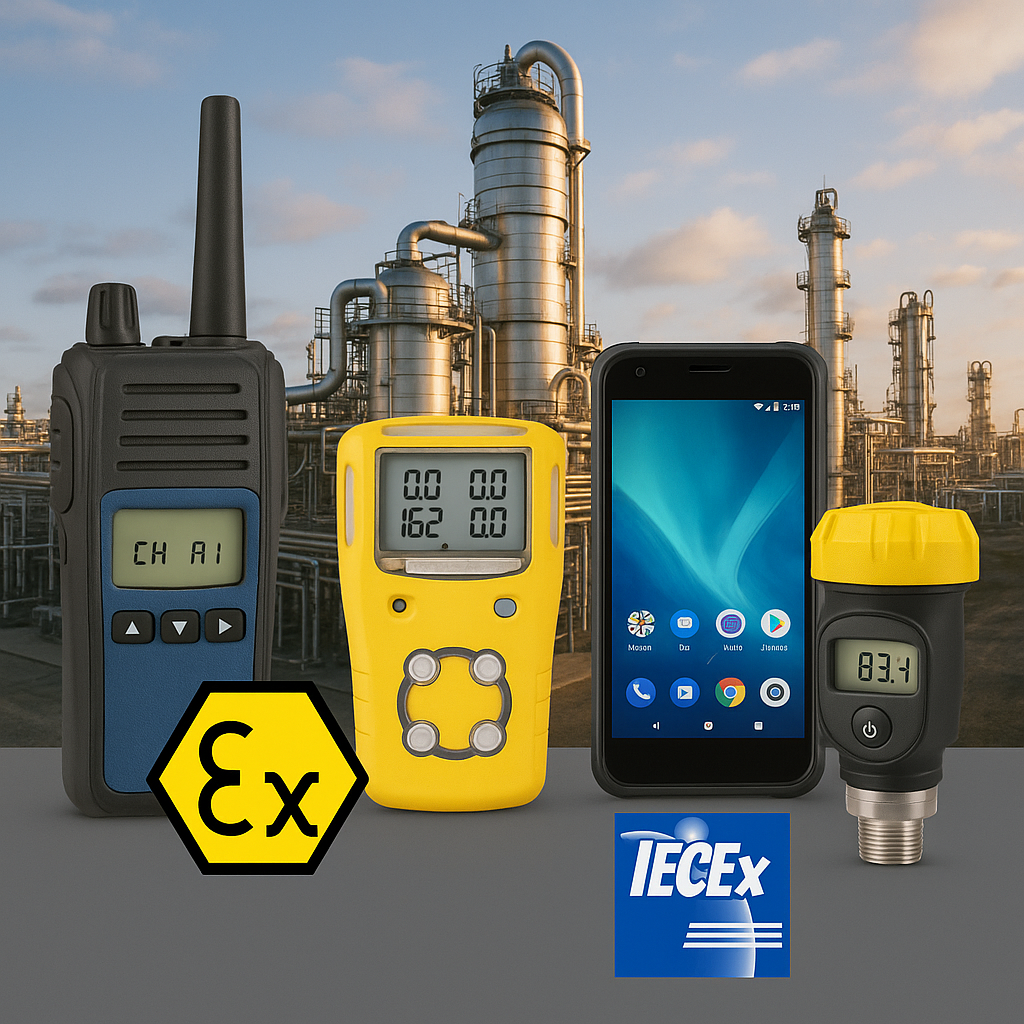
In industries where hazardous environments are a daily reality—like petrochemical facilities, offshore drilling rigs, grain processing plants, and mining—selecting the right certified equipment is not just about efficiency. It’s about life-saving safety and legal compliance. This is where intrinsic safety certifications, particularly ATEX and IECEx, become critically important.
If you’re selecting tools such as intrinsically safe smartphones, cameras, or gas detectors, understanding the nuances of ATEX vs IECEx will help you avoid regulatory issues, ensure proper use in explosive atmospheres, and streamline your operational processes. This in-depth guide will break down how these certifications compare, when and where each applies, and how to choose the right one for your facility or project.
What is ATEX Certification?
ATEX (derived from the French Atmosphères Explosibles) refers to two European Union directives related to explosive atmospheres. These directives are enforced across all EU member states and apply to both equipment manufacturers and end-users.
Breakdown of ATEX Directives:
-
Directive 2014/34/EU (ATEX 114) – Applies to equipment and protective systems intended for use in potentially explosive atmospheres. It is aimed at manufacturers.
-
Directive 1999/92/EC (ATEX 153) – Focuses on the safety of workers in explosive environments and is directed at employers and site operators.
Key Elements:
-
Applies within the European Economic Area (EEA): All member countries must adhere.
-
Mandatory for equipment used in hazardous zones, including oil refineries, chemical plants, and underground mines.
-
Products are assigned Equipment Groups and Categories:
-
Group I: Mining
-
Group II: Non-mining industries (oil, gas, manufacturing)
-
Category 1: Very high protection (Zone 0)
-
Category 2: High protection (Zone 1)
-
Category 3: Normal protection (Zone 2)
-
Marking Example:
A product label might include:Ex II 2G Ex db IIC T4 Gb
This marking denotes:
-
Group II (non-mining)
-
Category 2 (Zone 1)
-
Gas atmosphere
-
Explosion protection type “db”
-
Gas group IIC (most explosive gases)
-
Temperature class T4
If you’re operating in Europe, ATEX compliance is mandatory and legally enforced.
What is IECEx Certification?
IECEx stands for the International Electrotechnical Commission System for Certification to Standards Relating to Equipment for Use in Explosive Atmospheres. It’s a globally accepted system that ensures consistency in the certification of explosion-proof and intrinsically safe devices across international borders.
Unlike ATEX, which is legally binding only in Europe, IECEx is voluntary in many countries but highly respected. It is used to simplify international trade of compliant equipment, especially for companies with multinational operations.
Core Components of IECEx:
-
Based on international IEC standards (primarily the IEC 60079 series).
-
Equipment must pass rigorous third-party testing by approved IECEx certifying bodies.
-
A Certificate of Conformity (CoC) is published and publicly accessible via the IECEx website.
-
Covers both electrical and non-electrical equipment used in explosive atmospheres.
-
Hazardous area classifications and protection techniques mirror those of ATEX (Zones 0–2 for gas, Zones 20–22 for dust).
IECEx is rapidly becoming the preferred standard for global operations because of its transparency and international harmonization.
ATEX vs IECEx: What Are the Key Differences?
To clarify the comparison, here’s a comprehensive table outlining how ATEX vs IECEx certifications differ across several criteria:
| Feature | ATEX | IECEx |
|---|---|---|
| Region of Use | European Union (EU/EEA) | Global (Australia, Middle East, Africa, etc.) |
| Legal Status | Mandatory for hazardous zones in the EU | Voluntary, but recognized worldwide |
| Standards Used | EN (European Norms) | IEC (International Electrotechnical Commission) |
| Certification Body | EU “Notified Bodies” | IECEx accredited bodies |
| Marking Requirements | CE Mark + ATEX-specific Ex label | IECEx CoC + Ex labeling |
| Product Traceability | Requires Declaration of Conformity (DoC) | CoC published on IECEx website |
| Product Focus | Equipment and protective systems | Equipment, services, personnel competency |
| User Expectation | Regional compliance | Global recognition |
A Note on Global Projects:
Projects operating across continents often demand dual certification (both ATEX and IECEx) to ensure equipment can be accepted regardless of the local standards. This is particularly common in oil and gas, maritime, and military logistics industries.
When Should You Choose ATEX vs IECEx?
Do I need ATEX for European projects?
Yes. If your equipment is used in a hazardous area within the European Union or the EEA, ATEX certification is a legal requirement. There is no exception, and failure to comply can result in serious regulatory penalties or work stoppages.
What if I’m working outside the EU?
For operations in Australia, South Africa, Middle East, or any region where local law recognizes international standards, IECEx certification is usually sufficient. It ensures product integrity, quality control, and aligns with internationally accepted safety benchmarks.
Should I choose dual certification?
Dual-certified equipment is ideal if:
-
Your project spans multiple countries or jurisdictions.
-
You’re a distributor or integrator serving global clients.
-
You want to future-proof your equipment for cross-border transfers.
Despite the higher upfront cost, dual certification simplifies logistics, regulatory review, and global operations.
Can Devices Be Dual-Certified? Benefits and Drawbacks
Yes. Many products today are dual-certified for both ATEX and IECEx. This is especially common with high-demand devices like:
-
Explosion-proof smartphones and tablets
-
ATEX/IECEx certified cameras
-
Gas detectors and chemical analyzers
Benefits of Dual Certification:
-
Access to both EU and international markets
-
Fewer procurement roadblocks during bidding and specification
-
One product line for global deployment
-
Supports compliance in multinational joint ventures
Drawbacks:
-
Increased certification time
-
Slightly higher costs due to dual audits and documentation
-
Must maintain updates across two certification systems
Still, for companies serving high-risk industries worldwide, dual-certified products are the gold standard.
FAQs: ATEX vs IECEx Clarified
Can IECEx certified equipment be used in Europe?
Not without ATEX certification. Even though both use similar technical standards, IECEx alone is not legally accepted in the EU.
Are the technical standards in ATEX and IECEx different?
Mostly, they are based on the same IEC standards (e.g., IEC 60079). However, certification processes and regulatory oversight differ.
What’s the easiest way to check if a product is certified?
-
For IECEx, search the product’s CoC on the IECEx Certificate System.
-
For ATEX, refer to the CE and Ex markings on the product label and review the manufacturer’s DoC.
Is ATEX only for electrical equipment?
No. ATEX applies to both electrical and non-electrical equipment, including motors, mechanical seals, and enclosures.
What do Zone 0, Zone 1, and Zone 2 mean?
These refer to the frequency and duration of the presence of explosive gas or dust:
-
Zone 0: Constant or long-term presence
-
Zone 1: Likely presence during normal operations
-
Zone 2: Unlikely or short-term presence
Product Comparison: Certified Equipment from Intrinsically Safe Store
Here are top-rated dual-certified devices available now at Intrinsically Safe Store:
| Product | Certifications | Use Case | Key Features | Type |
|---|---|---|---|---|
| Ecom Smart-Ex 02 DZ1 | ATEX Zone 1, IECEx | Remote field communication | Android 11, LTE, rugged, glove-friendly | Smartphone |
| i.Safe MOBILE IS930.1 Tablet | ATEX Zone 1, IECEx | Maintenance, inspection, logistics | High-res screen, barcode reader, tough build | Tablet |
| Bartec Pixavi Cam | ATEX Zone 1, IECEx | HD documentation, remote inspection | 4K video, Wi-Fi, IP68, rugged design | Camera |
| RAE Systems MiniRAE 3000+ | ATEX Zone 1, IECEx | Real-time VOC gas detection | PID sensor, wireless transmission | Gas Detector |
Best Choice by Industry:
-
Oil & Gas: Smart-Ex 02 for voice/data communications in Zone 1
-
Utilities & Inspection: IS930.1 for digital workflows
-
Safety & Security Teams: Pixavi Cam for real-time imaging
-
Environmental Monitoring: MiniRAE 3000+ for high-accuracy VOC detection
Conclusion: Choose the Certification That Matches Your Environment
When it comes to ATEX vs IECEx, the right choice depends on your location, your industry, and your operational footprint. For European deployments, ATEX is non-negotiable. For international operations, IECEx ensures consistency and recognition.
If you’re unsure or your operations span multiple regions, choose dual-certified equipment for maximum flexibility, compliance, and peace of mind.