Intrinsically Safe Knowledge Base
Documentation Requirements for ATEX/IECEx Inspections
In the high-stakes world of hazardous area management, the focus often gravitates towards the tangible elements of safety—the robust explosion-proof enclosures, the meticulously routed armoured cables, and the complex intrinsically safe systems. While this hardware is undeniably the frontline defence against catastrophic events, it is the often-unseen and frequently underestimated paper trail that forms the true backbone of a compliant and genuinely safe operation. This comprehensive collection of certificates, reports, drawings, and records is far more than a bureaucratic necessity to be hastily assembled before an audit; it is the definitive legal and technical biography of your facility’s safety integrity. It provides the irrefutable proof of due diligence, the roadmap for effective maintenance, and the institutional memory that transcends personnel changes. This guide is designed to demystify the entire process, transforming what can feel like an overwhelming mountain of paperwork into a manageable and powerful asset. We will journey through the essential documents you must possess, clarify the chain of responsibility, and provide a practical framework for building and maintaining a verification dossier that not only satisfies an inspector but also unlocks a higher standard of operational excellence and safety for your entire organisation.
Master Hazardous Area Compliance
Building a robust verification dossier requires a solid understanding of global standards. Unsure which certification applies to your facility’s equipment? Read our detailed guide on the key differences between certifications to ensure a seamless inspection process.
Navigating the Paper Trail: Unpacking the Essential Documentation for ATEX and IECEx Inspections
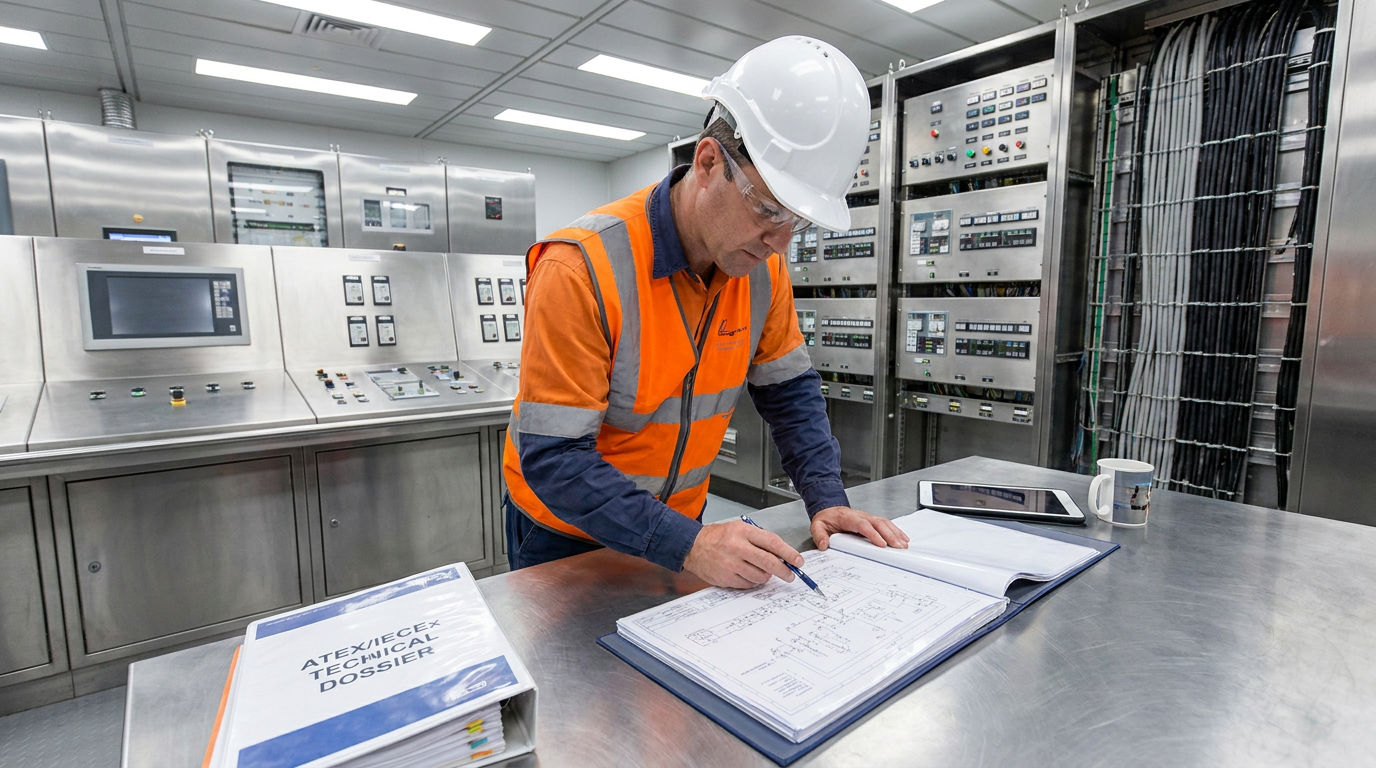
Embarking on an ATEX or IECEx inspection without the correct documentation is akin to navigating a treacherous sea without a map, a compass, or a logbook. It’s not just about having a few certificates on file; it’s about possessing a comprehensive and interconnected library of evidence that tells the complete safety story of your hazardous area operations. An inspector’s primary role is to verify that your facility is not just safe at the moment of their visit, but that a robust, documented system is in place to maintain that safety over the long term. This documentation is the very foundation upon which compliance is built. It serves as the tangible proof of your due diligence, demonstrating a systematic approach to identifying, assessing, and controlling explosion risks. Without this paper trail, even the most perfectly installed equipment is rendered non-compliant, as there is no verifiable proof of its suitability, its correct installation, or its ongoing integrity. The inspector is not there to guess or assume; they are there to audit a process, and that process must be meticulously recorded.
Key Documentation Requirements
- Hazardous Area Classification (HAC) Document: The foundational document that classifies hazardous areas into zones.
- Explosion Protection Document (EPD): A comprehensive safety management document that outlines risk assessments and mitigation measures.
- Certificates of Conformity: ATEX and/or IECEx certificates for all Ex equipment, proving they meet the required standards.
- Manufacturer’s Instructions: Installation, maintenance, and operation instructions for all Ex equipment.
- Verification Dossier: A complete lifecycle record of all Ex equipment, including an asset register, inspection records, and maintenance logs.

ATEX vs. IECEx Compliance Documentation
| Required Document | Core Purpose & Details | Framework | Primary Owner |
|---|---|---|---|
| Hazardous Area Classification (HAC) | Defines and maps specific explosion risk zones (Zones 0, 1, 2 / 20, 21, 22). Includes release source methodology and gas/dust characteristics. | Global / Regional | Facility Operator |
| Explosion Protection Document (EPD) | Comprehensive safety assessment proving that explosion risks have been determined and proper mitigation measures are implemented. | ATEX Directive | Facility Operator |
| Certificate of Conformity (CoC) | Legal proof that specific electrical or mechanical equipment meets rigorous safety standards for hazardous environments. | ATEX / IECEx | Equipment Manufacturer |
| Manufacturer Instructions | Mandatory guidelines detailing safe installation, precise technical operating limits, and specific Ex-certified maintenance procedures. | ATEX / IECEx | Equipment Manufacturer |
| Verification Dossier | Live history tracking initial, periodic, and sample inspections alongside validated records of any repairs or technical modifications. | IEC 60079-14 / 17 | Facility Operator |
Digitize Inspections with Intrinsically Safe Mobile Devices
Leave the manual paper trails and outdated clipboards behind. Equip your personnel with rugged, ATEX-certified tablets and smartphones to securely record inspection data from the field and update your Verification Dossier in real time.
FAQs
What is the “Verification Dossier” or “Explosion Protection Document,” and why is it so important?
The Verification Dossier or Explosion Protection Document (EPD) is the master file for all information related to explosion safety on your site. It’s the primary evidence that you are proactively managing explosion risks in a structured and compliant manner. An inspector will almost certainly ask to see this first, as it provides the overarching framework for your entire safety strategy.
Beyond the main dossier, what specific documents do I need for each piece of Ex equipment?
For each piece of Ex equipment, you need its Certificate of Conformity (ATEX or IECEx), the manufacturer’s Declaration of Conformity, and the manufacturer’s installation, maintenance, and operating instructions. These documents validate the equipment’s suitability and correct installation.
How detailed do my Area Classification drawings and reports need to be?
What kind of inspection and maintenance records will an inspector want to see?
Inspectors will want to see detailed records of initial, periodic, and sample inspections. These records should include the equipment tag, date, type of inspection, the inspector’s name, and a clear record of any faults found and corrective actions taken. Maintenance records should demonstrate that any work on Ex equipment was done by a competent person, using certified spare parts, and in accordance with the manufacturer’s instructions.
Who is responsible for maintaining this documentation?
Chat for a Quote
Call: 832-699-6726
Conclusion
As we conclude this deep dive into the world of ATEX and IECEx documentation, it is crucial to move beyond the individual checklists and requirements and embrace the overarching philosophy that underpins them. The meticulous records, certificates, and reports are not a burden to be borne, but a strategic asset to be cultivated. They are the tangible manifestation of your organisation’s commitment to safety, transforming abstract principles into a concrete, auditable, and defensible reality. By embedding this discipline into your processes, you transform the Verification Dossier from a static archive into a dynamic tool for risk management and operational improvement, ensuring that every component’s promise of safety is verifiable from the day it is installed to the day it is retired.