Intrinsically Safe Products
Explosion-Proof Emergency Stop Stations | C1D1 & ATEX Cert.
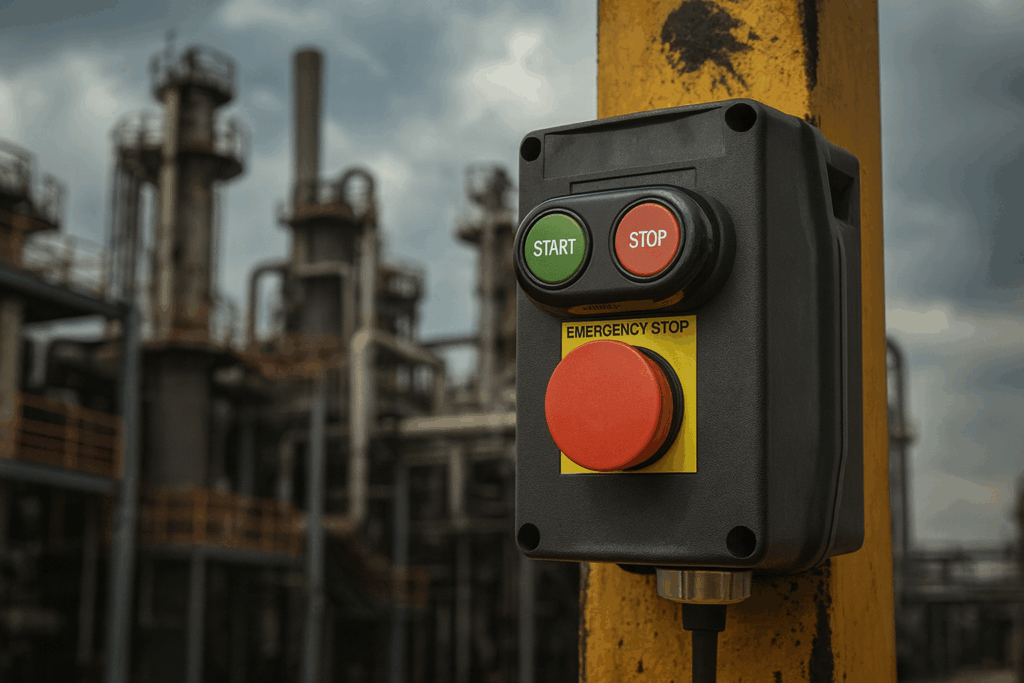
Emergency stop (E-stop) devices are fundamental to industrial safety. They allow operators to immediately halt equipment when a hazard is detected, reducing risks of injury, equipment damage, and process escalation. In hazardous locations, however, an E-stop must do more than shut down machinery—it must do so without introducing an ignition source. That is why the explosion proof emergency stop station is a critical component in oil and gas, chemical processing, refining, mining, pharmaceuticals, and other industries with explosive gases or dusts.
This guide explains how explosion-proof E-stops function, what certifications they require, enclosure considerations, placement rules, and wiring best practices to ensure safety and compliance.
What Is an Explosion-Proof Emergency Stop Station?
An explosion proof emergency stop station is a control device housed inside a certified enclosure designed to prevent internal sparks or arcs from igniting surrounding hazardous atmospheres. While a standard E-stop provides a mechanical means of stopping equipment, an explosion-proof model ensures that any electrical switching, fault condition, or internal failure remains contained.
Choose the Right Enclosure for a Compliant E-Stop System
Explosion-proof E-stops depend on certified housings that contain faults and preserve flame paths. If you’re planning a shutdown station for hazardous locations, start by selecting the correct enclosure strategy.
Core Functions of an Explosion-Proof E-Stop
-
Provide an immediate manual shutdown of connected equipment
-
Break control or power circuits safely in hazardous areas
-
Withstand internal electrical faults without igniting gases or dust
-
Maintain safety integrity even during component failure
-
Clearly signal emergency operation through a red, latching pushbutton
Explosion-proof E-stops are used on pumps, conveyors, mixers, hoists, packaging lines, cranes, and process equipment across many hazardous facilities.

Why Hazardous Areas Require Explosion-Proof E-Stops
Why is an explosion proof emergency stop station necessary?
Hazardous areas classified as Class I/II/III or ATEX Zones contain gases, vapors, or dust that can ignite from minor electrical activity. Pushbuttons and switches inherently produce arcs during activation. If housed in a standard enclosure, these arcs could ignite the atmosphere. Explosion-proof stations prevent this through flameproof or increased-safety design.
Common Hazards That Make E-Stops Critical
-
Pressurized flammable gas releases
-
Chemical spills or vapor emissions
-
Mechanical equipment failure
-
Conveyor jams or blade blockages
-
Worker entanglement or near-miss events
Explosion-proof E-stops allow workers to stop processes instantly while ensuring the stop device itself cannot trigger combustion.
Understanding Certifications for Explosion-Proof E-Stops
Common Certifications for Explosion-Proof E-Stops
Selecting a compliant station starts with verifying the correct hazardous-location approvals. These certificates define where and how the equipment may be used.
ATEX Certifications
Explosion-proof stations used in the European Union must comply with ATEX Directive 2014/34/EU.
ATEX Zones
-
Zone 0: Continuous hazardous atmosphere
Typical marking example:
II 2G Ex d IIC T6 Gb
IECEx Certification
IECEx ensures global harmonized standards and testing. Many international facilities require both IECEx and ATEX markings for equipment traceability and global acceptance.
North American NEC/CEC Class/Division System
Used in the United States and Canada:
-
Class II: Combustible dust
-
Class III: Fibers and flyings
-
Division 2: Hazard present only during abnormal operation
Appropriate approvals depend on the specific industrial environment.
Temperature Classes and Gas Groups
E-stop stations must meet temperature and gas group requirements:
-
T1–T6 temperature codes limit surface temperature
-
Gas groups IIA, IIB, IIC define allowable environments with increasing risk
-
Dust groups IIIA, IIIB, IIIC address particle-based ignition hazards
Checking these details is essential to ensure the device is safe for the intended area.
Enclosure Requirements for Explosion-Proof E-Stops
What enclosure features matter most for an explosion-proof emergency stop station?
The enclosure is the heart of explosion protection. It must withstand internal ignition, dissipate heat, and maintain certified flame paths.
Key Enclosure Design Elements
Flameproof Construction (Ex d)
-
Heavy-duty metal housings (aluminum, steel, or stainless steel)
-
Precisely machined flame paths that cool escaping gases
-
Strong threaded or bolted joints
Increased-Safety Enclosures (Ex e)
-
No arcs or sparks allowed inside
-
Reinforced insulation and component spacing
-
High ingress protection (IP66–IP67)
Dust-Ignition-Proof Enclosures (Ex tb)
-
Prevent dust infiltration or ignition
-
Maintain surface temperatures below dust ignition limits
Mechanical Protection Ratings
Explosion-proof enclosures typically include:
-
IP65–IP67 ingress protection
-
Impact resistance to withstand industrial abuse
-
Corrosion-resistant finishes for chemical or marine environments
-
Wide temperature range performance for outdoor or extreme climates
Operational Interface Requirements
-
Large red mushroom-style pushbutton
-
Latching (twist or pull-to-reset) operation
-
Shrouded or guarded designs to avoid accidental activation
-
Optional illumination or integrated pilot lights (if certified)
Build a Quote-Ready E-Stop Control Setup
A robust hazardous-area shutdown design often includes certified junction boxes and signal protection components that support clean, compliant wiring and safer control-loop integration.
Best Practices for E-Stop Placement in Hazardous Areas
How should an explosion-proof emergency stop station be positioned?
Correct placement ensures operators can reach the E-stop quickly during emergencies. Standards such as ISO 13850 and IEC 60204-1 help define positioning requirements.
Placement Principles
Accessibility
-
Install stations at arm’s reach from operating positions
-
E-stops must be visible, unobstructed, and clearly identified
-
Stations should not require bending, climbing, or reaching through machinery
Line-of-Sight Requirements
Technicians must be able to see what they are stopping. Misplaced E-stops can create unintended hazards.
Height and Orientation
Stations should be installed at a height that is easily accessible to operators without bending or reaching, as defined by relevant site and ergonomic standards.
Clustering and Distributed Locations
Complex machinery may require multiple emergency stop points along:
-
Conveyor lines
-
Catwalks
-
Pump skids
-
Valve manifolds
-
Reactor zones
Hazard-Based Location Strategy
-
Place E-stops near known hazard points
-
Install additional units in areas with rapid-change operations
-
Include stations near maintenance access points for safety during servicing
Wiring and Installation Best Practices
What wiring rules apply to explosion-proof emergency stop stations?
Wiring in hazardous areas must meet strict mechanical and electrical safety standards. Any improperly sealed cable or conduit may transmit ignition between equipment or allow flammable gas ingress.
Cable Entry Requirements
-
Installation standards like IEC 60079-14 require the use of appropriately certified Ex cable glands that match the enclosure’s protection method and the type of cable used.
-
To maintain the integrity of a flameproof (Ex d) enclosure’s flame path, standards require that all threaded fittings meet the manufacturer-specified minimum thread engagement.
-
Installation codes require that any reducers, adaptors, or stopping plugs used to seal unused entries must also be certified for the hazardous location and be compatible with the enclosure’s protection method.
Conduit and Cable Protection
-
Seal off conduit entries as required by code
-
Prevent gas migration through cable sheaths
-
Maintain grounding and bonding continuity
-
Support cables to reduce vibration stress
Internal Wiring Requirements
-
Internal wiring must be routed to preserve the creepage and clearance distances established by the equipment’s certification and design standards to prevent internal faults.
-
Prevent wiring from obstructing flame paths
-
Use insulated conductors approved for hazardous areas
Safety Circuit Integration
Explosion-proof E-stops must be integrated into a compliant safety control system. Typical scenarios include:
-
Direct control circuit interruption
-
Integration with Safety PLC or functional safety systems
-
Redundant channel wiring for SIL-rated systems
-
Fail-safe design ensuring de-energized safe state
Integrating E-Stops into a Functional Safety System
While an explosion-proof E-stop is a critical hardware component, its true value is realized when integrated into a comprehensive functional safety system. Modern industrial automation relies on structured safety architectures, often defined by standards like IEC 61508 and IEC 61511, to achieve a specific Safety Integrity Level (SIL). An E-stop is a key input to this system, but it does not function in isolation.
The Role of SIL Ratings
A Safety Integrity Level (SIL) rating quantifies the risk reduction provided by a safety function. E-stop circuits are often required to meet SIL 2 or SIL 3, depending on the process risk assessment. Achieving this requires more than just a certified button. It involves analyzing the entire safety loop, including the E-stop contacts, wiring, logic solver (like a safety PLC or safety relay), and final control elements (like motor contactors or valve actuators). The reliability of each component contributes to the overall SIL capability.
Redundancy and Diagnostics
To meet higher SIL ratings, E-stop circuits often employ redundancy. This typically means using an E-stop with dual-channel contacts. The safety PLC monitors both channels simultaneously. If one contact fails to open or welds shut, the PLC detects the discrepancy and can still initiate a safe shutdown using the second channel. This design prevents a single point of failure from compromising the emergency stop function. Furthermore, the PLC provides diagnostics, alerting operators to a fault in the E-stop circuit so it can be serviced before a real demand occurs.
Maintenance, Inspection, and Testing
Installing a certified explosion-proof E-stop station is only the first step. To ensure it remains compliant and functional throughout its lifecycle, a robust maintenance and inspection program is mandatory. Neglecting these devices can lead to catastrophic failures, defeating their purpose. Regular checks are required by standards such as NFPA 70B and internal company safety protocols.
Routine Visual and Mechanical Checks
At regular intervals, qualified personnel should perform a series of checks. Visually, this includes ensuring the enclosure is free from significant corrosion, damage, or unauthorized modifications. All certification labels must be legible. Mechanically, the E-stop button should be activated to confirm it latches correctly and requires a deliberate action (twist, pull, or key release) to reset. The mounting should be secure, and any protective shrouds must be in place. Cable entries and glands should also be inspected for tightness and signs of degradation.
Functional and Electrical Testing
Beyond physical checks, periodic functional testing is critical. This involves activating the E-stop station to verify that it correctly de-energizes the machinery’s control circuit. This test confirms the integrity of the internal contacts and the wiring to the control panel. For dual-channel systems, testing may need to verify that the safety relay or PLC correctly processes the inputs. All test results, inspections, and maintenance actions must be documented in a log to maintain a complete compliance record for the equipment.
Comparison Table: Standard vs. Explosion-Proof E-Stop Stations
| Feature | Standard E-Stop | Explosion-Proof E-Stop |
|---|---|---|
| Hazardous Area Placement | Not allowed | Approved for Ex zones |
| Enclosure Type | Plastic/metal | Flameproof or Ex e/tb certified |
| Ignition Safety | Not protected | Prevents ignition under fault |
| Certifications | Basic electrical | ATEX, IECEx, NEC/CEC |
| Wiring Requirements | Standard | Ex-rated with sealing |
| Use Case | General industry | Hazardous locations |
Industry Use Cases for Explosion-Proof E-Stop Stations
Explosion-proof E-stop systems are used across industries where flammable atmospheres exist and rapid shutdown is essential.
Oil & Gas
-
Drilling rigs
-
Compressor stations
-
Refinery processing units
Chemical & Petrochemical
-
Reactors
-
Distillation and blending units
-
Tank farms and loading racks
Mining
-
Underground equipment
-
Crushers, conveyors, and dust-prone operations
Food & Grain Processing
-
Mills, silos, and grain elevators with combustible dust
Pharmaceuticals
-
Powder handling
-
Solvent-based processing areas
Water Treatment & Utilities
-
Chlorine rooms
-
Methane-prone wastewater operations
Across these industries, explosion-proof E-stops support safe, compliant shutdown procedures.
Need help specifying the right hazardous-area solution?
If you’re selecting an explosion-proof E-stop station, enclosure, or related control components, our specialists can help you validate ratings, installation fit, and compliance requirements before you request a quote.
FAQs About Explosion-Proof Emergency Stop Stations
Are explosion-proof E-stops the same as intrinsically safe E-stops?
No. Explosion-proof E-stops prevent ignition by containing internal explosions, while intrinsically safe devices limit energy to prevent ignition. E-stops typically require explosion-proof or increased-safety designs because they involve switching that may arc.
Can explosion-proof E-stops be installed outdoors?
Yes. Many models offer IP66–IP67 protection and corrosion-resistant housings meant for outdoor hazardous areas.
Do E-stops require regular inspection?
Yes. Inspections must verify flame paths, cable gland torque, gasketing (if applicable), proper labeling, and correct safety circuit performance.
Can a single E-stop control multiple machines?
Yes, if integrated properly into the safety control architecture. However, each machine zone typically requires its own E-stop for visibility and accessibility.
Do explosion-proof E-stops require special maintenance?
Routine maintenance includes checking for corrosion, ensuring all screws remain properly torqued, inspecting flameproof joints, and verifying circuit continuity.
Conclusion
Choosing the right explosion proof emergency stop station is essential for protecting workers and maintaining compliance in hazardous facilities. Proper enclosures, correct hazardous-area certifications, optimized placement, and compliant wiring practices all contribute to a reliable emergency shutdown system. In environments where flammable gases or dusts are present, a standard E-stop cannot provide the necessary protection—only certified explosion-proof equipment ensures safe operation.
Explosion-proof E-stops reduce risk, improve safety response times, and support regulatory compliance across industries. When selecting equipment, it’s essential to consider certification markings, environmental durability, enclosure construction, and integration with safety circuits.