Intrinsically Safe Products
Explosion-Proof Push Buttons: C1D1/ATEX Certified | ISS
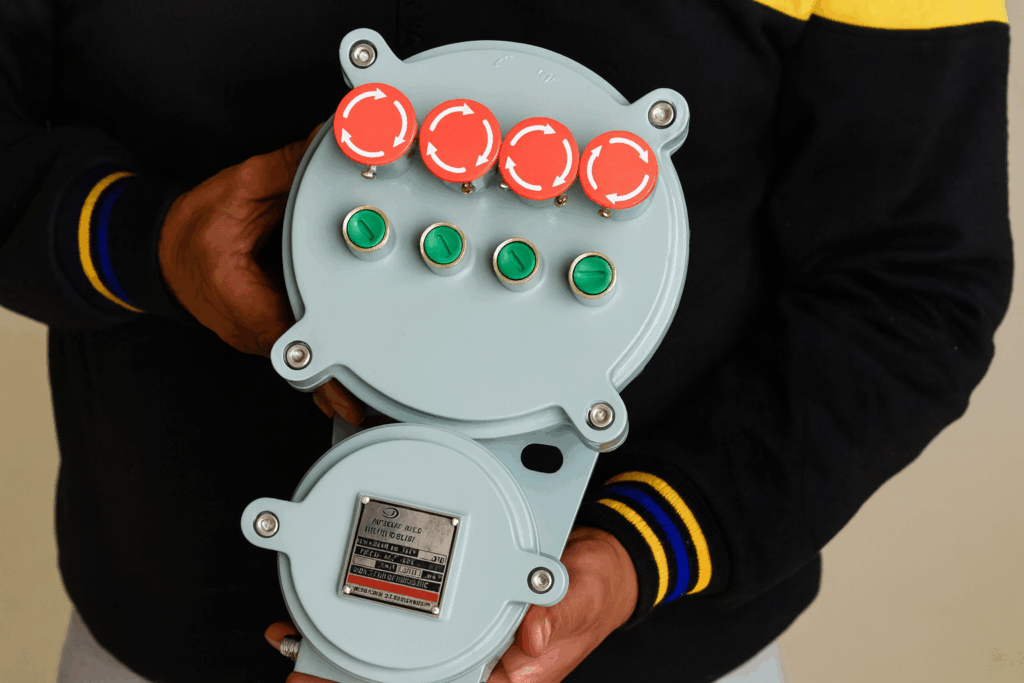
Explosion-proof push button stations are essential components in hazardous industrial environments where flammable gases, vapors, or dusts pose ignition risks. These control devices allow personnel to safely operate equipment, activate emergency functions, and manage machinery without compromising safety. In industries such as oil and gas, chemical processing, mining, and manufacturing, selecting the right explosion proof push button station is crucial to maintaining compliance and ensuring continuous, safe operations.
This comprehensive guide covers station types, enclosure materials, labeling requirements, Ex ratings, installation best practices, and recommended certified solutions.
What Is an Explosion-Proof Push Button Station?
An explosion-proof push button station is a control device designed to prevent internal sparks, arcs, or heat from igniting the surrounding hazardous atmosphere. It houses electrical contacts within a certified enclosure strong enough to contain any internal explosion.
These stations are designed for safe machine operation in areas classified as Class I, II, III (NEC) or Zone 1 and Zone 2 (ATEX/IECEx).
Need certified protection for your control stations?
Browse Certified Explosion Proof Enclosures
Find ATEX & IECEx certified enclosures that keep your control stations safe and compliant.
Why Are Explosion-Proof Push Button Stations Required in Hazardous Areas?
They are required because standard electrical switches or control devices can spark when operated. In hazardous locations containing flammable gases or combustible dust, even a small spark can lead to catastrophic fires or explosions. Explosion-proof stations isolate ignition sources and maintain safe working conditions.
Regulatory bodies like NEC, NFPA, ATEX, and IECEx mandate certified devices in classified areas.
What Are the Main Types of Explosion-Proof Push Button Stations?
Explosion-proof stations vary based on function, control requirements, and operational design.
1. Standard Push Button Stations
These include basic ON/OFF momentary or maintained switches used for machine start/stop functions. A momentary switch returns to its original position when released, while a maintained switch stays in its actuated position until manually reset. The choice between them depends on the control logic required; momentary switches are common for jogging a motor, while maintained switches are used for continuous operation.
2. Selector Switch Stations
Used for multi-position control (e.g., Hand/Off/Auto). Ideal for equipment requiring mode selection. These switches can have two, three, or more positions and are often keyed to restrict operation to authorized personnel. They are essential for managing complex processes, such as selecting between local and remote control of a pump system in a Class I, Division 2 area.
3. Emergency Stop (E-Stop) Stations
Feature red mushroom-head actuators designed for immediate shutdown of machinery. Required for safety compliance. These are typically twist-to-release or pull-to-release and must be easily accessible. E-stop circuits are designed to be fail-safe, ensuring that the machinery stops even if power to the control circuit is lost.
4. Control & Signaling Combination Stations
Combine push buttons, pilot lights, and selector switches into one enclosure for complex operational workflows.
5. Magnetic Starter Push Button Stations
Used with motor starters to control motors in hazardous areas.
Building a complete safety solution for hazardous areas?
View Certified Ex d Enclosures
Explore Portable Gas Detectors
Pair certified enclosures with gas detectors to reduce ignition risks and meet NEC, ATEX, and IECEx standards.
What Enclosure Materials Are Used in Explosion-Proof Push Button Stations?
Enclosure materials impact corrosion resistance, weight, temperature handling, and durability.
Common Materials
Aluminum
-
Lightweight
-
Good corrosion resistance when coated
-
Widely used in oil and gas
Stainless Steel
-
Highest corrosion resistance
-
Suitable for marine, offshore, and chemical environments
-
More expensive but extremely durable
Polyester/GRP (Glass Reinforced Plastic)
-
Corrosion-proof
-
Lightweight and UV-resistant
-
Ideal for Zone 1/Zone 2 chemical and wastewater industries
Cast Iron
-
Very strong
-
Heavier and more susceptible to corrosion
-
Used in rugged industrial applications
Understanding Ex Ratings for Explosion-Proof Push Button Stations
Explosion-proof stations must be marked with specific Ex ratings to show they are suitable for hazardous areas.
ATEX/IECEx Ratings
-
Ex d — Flameproof enclosure
-
Ex e — Increased safety
-
Ex tb — Dust protection
-
Equipment Group II — Non-mining industries
-
Gas Groups: IIA, IIB, IIC
-
Temperature Classes: T1–T6
NEC/CEC Class/Division Ratings
-
Class I: Gases and vapors
-
Class II: Dusts
-
Class III: Fibers
-
Division 1: Hazard present during normal operation
-
Division 2: Hazard present only under abnormal conditions
Recognizing these markings ensures compliance and proper device selection.
Need a deeper dive into hazardous area classification?
What Is ATEX Certification?
ATEX vs IECEx Explained
Class I Div 1 vs Class I Div 2
How Do Explosion-Proof Push Button Stations Work?
Explosion-proof stations house switches inside an enclosure designed to contain any ignition event. The enclosure absorbs pressure, cools escaping gases through flame paths, and prevents ignition from spreading outside the enclosure.
Internal components may include:
-
Contact blocks
-
Spring return mechanisms
-
Terminal connections
-
Waterproof gaskets
-
Flame paths and threaded joints
How to Choose the Right Explosion-Proof Push Button Station?
Choosing the correct station depends on hazardous classification, application needs, and usage conditions.
Key Selection Criteria
-
Hazardous Area Classification (NEC or ATEX/IECEx)
-
Control Function (start, stop, E-stop, mode selection)
-
Enclosure Material (aluminum, stainless steel, GRP)
-
Ingress Protection Rating (IP65, IP66, IP67)
-
Number of Operators (single or multi-function)
-
Environmental Conditions (corrosive, dusty, offshore)
Not sure which explosion-proof push button station fits your application?
Get Expert Advice on Station Selection
Our team can help you match the right station, enclosure, and rating to your site conditions.
Explosion-Proof Push Button Stations Sold at Intrinsically Safe Store
Below are top-rated certified models
1. Killark XCS Explosion-Proof Push Button Station
A durable aluminum station widely used in refineries and petrochemical operations.
Key Features
-
Multiple button configurations
2. Crouse-Hinds EFS Series Push Button Station
Reliable, rugged, and designed for severe industrial conditions.
Key Features
-
Explosion-proof aluminum body
-
NEC Class I, Division 1 & 2; Class II, Division 1 & 2 certified.
-
Supports pilot lights, selector switches, E-stops
-
Highly configurable
3. Cortem CCA Series ATEX Push Button Control Station
A corrosion-resistant GRP station made for Zone 1 & Zone 2 areas.
Key Features
-
UV-resistant GRP enclosure
-
Lightweight and modular
-
Ideal for offshore environments
Comparison Table: Explosion-Proof Push Button Stations
| Feature / Model | Killark XCS | Crouse-Hinds EFS | Cortem CCA (ATEX) |
|---|---|---|---|
| Certification | Class I–III, Div 1/2 | Class I & II | ATEX/IECEx Zone 1/2 |
| Enclosure Material | Aluminum | Aluminum | GRP |
| Ingress Rating | IP66 | IP66 | IP66–IP67 |
| Available Functions | PB, selector, E-stop | PB, selector, pilot light | PB, selector, pilot light |
| Best For | Oil & Gas | Petrochemicals | Offshore & chemical sites |
Best Choice Summary
-
Best for Heavy-Duty Oil & Gas Work: Killark XCS
-
Best for Multi-Function Control: Crouse-Hinds EFS
-
Best for Corrosive/Marine Environments: Cortem CCA
How Do You Install an Explosion-Proof Push Button Station?
Installation must follow ATEX/IECEx or NEC guidelines, depending on the region.
Installation Requirements
-
Installation standards, such as NEC Article 501 for North America or IEC 60079-14 internationally, require the use of certified cable glands compatible with the enclosure’s protection method and rating.
-
To maintain the integrity of the flame path, installation standards require that all threaded joints are fully engaged according to manufacturer specifications (e.g., with at least five full threads engaged for NPT).
-
Inspection and maintenance standards (e.g., IEC 60079-17) mandate that flame path surfaces must be kept clean, undamaged, and free of unauthorized lubricants or paint to ensure their effectiveness.
-
Properly ground the enclosure
-
Use rigid metal conduit where required
-
Mount within accessible height range (per OSHA/NFPA guidelines)
What Are Common Mistakes During Installation?
Avoiding errors is critical to keeping the certification intact.
Common Issues
-
Mixing uncertified components
-
Overtightening threaded joints
-
Using incompatible cable glands
-
Drilling or modifying enclosures (not permitted)
-
Failing to maintain flame paths
Even minor unauthorized modifications void certification.
Maintenance and Inspection of Explosion-Proof Push Button Stations
Proper maintenance and regular inspection are critical for ensuring that explosion-proof push button stations retain their safety certifications and function reliably over their lifespan. Neglecting maintenance can compromise the integrity of the enclosure, leading to a loss of protection and creating a significant safety risk. A structured inspection plan should be part of any facility’s safety protocol.
Key Inspection and Maintenance Procedures
Certified personnel should perform these checks at regular intervals, as defined by facility standards and manufacturer recommendations:
- Visual Inspection: Check the enclosure for any signs of physical damage, corrosion, or cracks. Ensure all bolts and fastenings are tight and that there is no deformation of the housing.
- Gasket and Seal Integrity: Inspect all gaskets and seals for signs of wear, brittleness, or damage. A compromised seal can allow hazardous gases or dust to enter the enclosure, defeating its purpose. Replace gaskets according to the manufacturer’s schedule.
- Flame Path Inspection: The flame paths (the tight joints between enclosure parts) are essential for cooling hot gases. Ensure these surfaces are clean, free of debris or corrosion, and have not been painted over or lubricated with unapproved substances.
- Actuator and Operator Functionality: Test all push buttons, switches, and E-stops to confirm they operate smoothly and correctly. The spring return on momentary buttons should be crisp, and E-stops should latch and release as designed.
- Cable Glands and Conduit Entries: Verify that cable glands and conduit entries are secure and properly sealed. A loose entry point can compromise the enclosure’s IP rating and explosion-proof characteristics. Check for compliance with ATEX and IECEx standards.
- Check for Unauthorized Modifications: Ensure no unauthorized drilling, cutting, or other modifications have been made to the enclosure. Any such changes immediately void the device’s certification.
Which Industries Use Explosion-Proof Push Button Stations?
These stations are used in any industry where hazardous gases or dusts are present.
Primary Sectors
-
Oil & Gas (Upstream, Midstream, Downstream)
-
Petrochemical & Chemical Processing
-
Food Processing (dust hazards)
-
Mining
-
Wastewater Treatment
-
Pharmaceutical Manufacturing
-
Power Generation
Industry Metrics: Reliability & Safety Performance
Data aggregated from NFPA, OSHA, and IEC studies shows:
-
Electrical equipment causes ~25% of industrial explosions
-
Explosion-proof devices reduce ignition risks by up to 90%
-
Corrosion-resistant enclosures extend device lifespan by 40–60%
-
Proper ATEX installation decreases failure rates by up to 50%
Safety Benchmark Summary
| Metric | Non-Explosion-Proof | Explosion-Proof |
|---|---|---|
| Ignition Risk | High | Very Low |
| Avg. Lifespan | 3–5 years | 7–10 years |
| Compliance Level | Non-compliant | Fully compliant |
| Failure Rate | 15–25% | 3–5% |
FAQs About Explosion-Proof Push Button Stations
Are explosion-proof push button stations the same as intrinsically safe devices?
No. Explosion-proof devices contain explosions, while intrinsically safe devices limit energy to prevent ignition.
Can I install a non-rated station in a hazardous area?
No. Doing so violates ATEX, NEC, and OSHA regulations and may lead to fires or explosions.
What temperature class should I choose?
Choose a temperature class lower than the ignition temperature of the surrounding gases (e.g., T4, T5, T6).
Can I modify a station by drilling extra holes?
No. Modifying an explosion-proof enclosure immediately voids certification.
Do I need a certified cable gland?
Absolutely. Cable glands must match enclosure certification (e.g., Ex d, Ex e).
Ready to design a complete explosion-proof control solution?
Design Your Custom Control Station
View Rugged Zone 1/21 Mobile Devices
Find ATEX-Certified Camera Solutions
Want to equip your team with certified smartphones too?
See the Best Intrinsically Safe Smartphones
Prefer to talk to us directly?
Call a specialist at +1 (832) 699-6726
Conclusion: Choosing the Best Explosion-Proof Push Button Station
Selecting the right explosion proof push button station ensures safe and compliant operation in hazardous locations. Whether you need a simple start/stop button, a multi-function control panel, or a corrosion-resistant GRP enclosure for offshore use, certified stations from Killark, Crouse-Hinds, and Cortem offer the performance and safety required for demanding environments.