Intrinsically Safe Products
Mastering Intrinsic Safety: The Definitive Guide to Barrier Selection and Installation
In the high-stakes world of industrial processing, where a single stray spark can have catastrophic consequences, the concept of intrinsic safety stands as a testament to proactive, intelligent engineering. It is a safety philosophy built not on containing an explosion, but on preventing the fundamental conditions for ignition from ever arising. At the very core of this elegant approach lies a small but profoundly important component: the intrinsic safety barrier. This device is the silent, unwavering guardian that stands between the high-energy world of the control room and the volatile, potentially explosive atmosphere of the plant floor. For engineers, technicians, and safety professionals, understanding how to select, install, and maintain these barriers is not merely a technical skill; it is a fundamental responsibility. This comprehensive guide is designed to demystify the entire process, transforming a complex web of standards, calculations, and best practices into a clear and actionable roadmap. We will journey deep into the principles of energy limitation, explore the critical differences between Zener barriers and galvanic isolators, master the non-negotiable entity parameter calculations, and detail the meticulous installation practices that ensure the integrity of the entire safety system.
Confused by Zone and Division Requirements?
Don’t finalize your safety design without a precise understanding of your hazardous area classification. Review our deep dive into Classes, Divisions, and Zones before you select your barrier.
Demystifying Intrinsic Safety Barriers: A Deep Dive into Selection and Installation
Navigating the world of hazardous area protection can feel like learning a new language, one filled with acronyms, standards, and complex principles. At the heart of one of the most elegant and widely used protection methods, Intrinsic Safety (IS), lies a critical component: the intrinsic safety barrier. Understanding what this device is, how it works, and the nuances of selecting and installing the correct one is not just a matter of operational efficiency; it is a fundamental pillar of process safety. An IS barrier is the unassuming guardian standing between the high-energy world of your control room and the volatile, potentially explosive atmosphere of your plant floor. Its sole purpose is to act as an energy-limiting interface, ensuring that under both normal and specific fault conditions, the electrical energy and power sent to a field device—be it a sensor, switch, or transducer in the hazardous area—is too low to ignite a flammable gas, vapor, or dust cloud. It achieves this by rigorously clamping voltage and limiting current to levels below the minimum ignition energy of the surrounding atmosphere, effectively preventing sparks and hot surfaces that could lead to a catastrophic event.
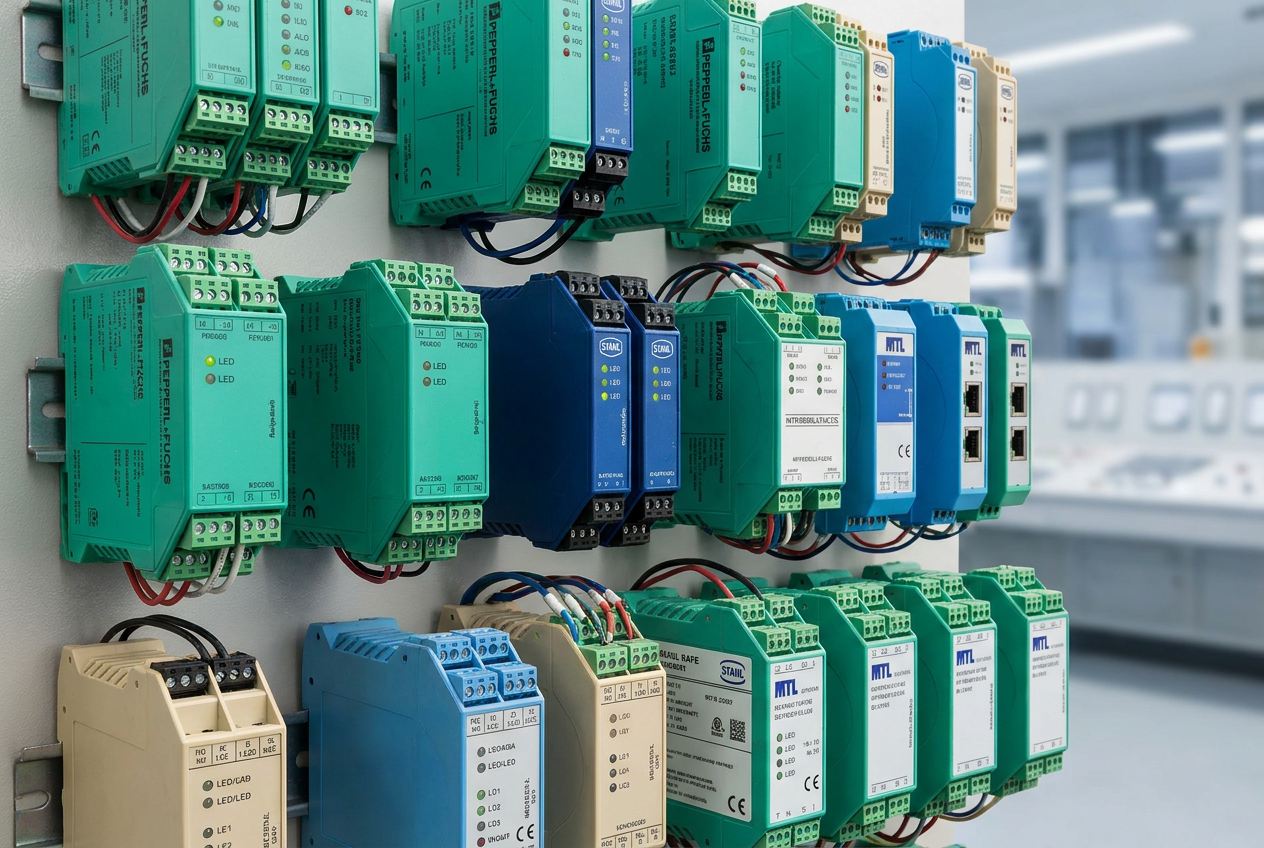
- Zener Barriers: Simple, cost-effective, and reliable, but require a dedicated, high-integrity intrinsic safety ground.
- Galvanic Isolators: Offer complete electrical isolation, eliminating the need for an IS ground and providing superior signal quality, but at a higher initial cost.
- Entity Parameters: The non-negotiable calculations (Vmax, Imax, etc.) that are used to mathematically verify the loop components are compatible and meet the requirements of intrinsic safety standards.

Getting Started with Intrinsic Safety Barriers: Your Guide to Selection and Installation
Embarking on the journey of implementing an intrinsically safe system can feel like navigating a complex labyrinth of regulations, calculations, and engineering principles. The selection and installation of the intrinsic safety (IS) barrier, the heart of the system, is where the theoretical meets the practical. This critical component acts as the gatekeeper, ensuring that only a safe, non-incendive level of energy can pass from the control room into a potentially explosive atmosphere. Getting this stage right is not just a matter of operational efficiency; it is a fundamental requirement for the safety of personnel, the protection of assets, and compliance with stringent international standards. A methodical and informed approach transforms this seemingly daunting task into a manageable process, ensuring your hazardous area instrumentation is both functional and, most importantly, safe.
- Define the Environment: Identify the hazardous area classification (Zone/Division), Gas Group, and Temperature Class.
- Perform Entity Parameter Matching: Calculate and verify the compatibility between the barrier, field device, and cable.
- Choose Barrier Technology: Decide between Zener barriers and galvanic isolators based on your application’s specific needs and constraints.
Advanced Considerations for Barrier Selection and Installation
While entity parameter calculations are the foundation of a safe IS system, several practical considerations can influence the long-term reliability and safety of your installation. A truly robust design accounts not only for the numbers but also for the real-world challenges of installation and maintenance.
Zener vs. Galvanic Isolator: A Practical Decision Matrix
The choice between a Zener barrier and a galvanic isolator often goes beyond the initial cost. Consider these factors:
- Grounding Integrity: Zener barriers are entirely dependent on a dedicated, low-impedance IS ground. While installation standards define the specific requirements, a common industry best practice is to target a connection resistance of less than 1 Ohm. In applications where a stable, low-impedance ground connection as specified by installation standards cannot be assured, galvanic isolators are often selected because their safety function does not depend on a ground connection.
- Signal Integrity & Noise: Galvanic isolators use transformers or optocouplers to create complete electrical separation between the safe and hazardous area circuits. This isolation breaks ground loops and provides superior protection against electrical noise, making them ideal for sensitive analog signals (like thermocouples) or installations in electrically noisy environments.
- Panel Space and Density: Modern multi-channel galvanic isolators can offer higher channel density than their Zener counterparts, saving valuable cabinet space in large-scale projects.
- Application Complexity: For simple switch inputs where cost is the primary driver and a good ground is available, Zener barriers are a viable solution. For complex control loops, analog signals, or retrofitting into existing plants with unknown grounding systems, galvanic isolators provide a more robust and trouble-free solution.
Common Installation Pitfalls and How to Avoid Them
A perfectly selected barrier can be rendered unsafe by improper installation. Be vigilant about these common errors:
- Incorrect Grounding: The most frequent failure point for Zener barrier systems. Installation standards such as IEC 60079-14 specify requirements for IS grounding, which typically include using a dedicated connection to the equipotential bonding system and prohibit practices like ‘daisy-chaining’ to maintain integrity.
- Cable Segregation Violations: To prevent non-IS circuits from inducing unsafe energy levels into IS circuits, standards like IEC 60079-14 mandate strict segregation. This often requires running IS wiring in separate conduits or maintaining specific separation distances from non-IS wiring.
- Improper Cable Glands and Terminations: Ensure that all enclosures and junction boxes use correctly rated cable glands. Terminals for IS circuits should be clearly marked and separated from non-IS terminals within the same enclosure.
- Lack of Documentation: Every IS loop must be documented with a loop diagram showing the barrier, field device, cable parameters, and the entity parameter calculations. This documentation is essential for verification, maintenance, and future troubleshooting. For expert verification, you can always consult with our hazardous area specialists.
Ultimate Energy-Limiting Solutions
| Product | Category | Main Specs | Price | Internal Link |
|---|---|---|---|---|
| ZSB-409A Intrinsically Safe | Zener Barrier |
|
$684.03 | View Details |
| Eaton MTL5541 Signal Repeater | Galvanic Isolator |
|
$1,000.00 | View Details |
| Eaton MTL5511 Analog Input | Multi-Channel Barrier |
|
$650.00 | View Details |
Certified Protection for Every Loop
From single-channel Zener barriers to advanced multi-channel galvanic isolators, ensure your facility meets UL, ATEX, and IECEx standards. Browse our curated selection of high-performance energy-limiting interfaces.
Related Resources
FAQs
What exactly is an intrinsic safety barrier, and why is it so important?
An intrinsic safety barrier is a critical protective device that limits the energy flowing into a hazardous area, preventing explosions by ensuring the electrical energy is too low to cause ignition. It’s the core of the intrinsic safety protection method.
What is the real difference between a Zener barrier and a galvanic isolator, and how do I choose?
A Zener barrier shunts excess energy to a high-integrity ground, while a galvanic isolator provides complete electrical isolation. Choose a Zener for simpler, cost-sensitive projects with good grounding, and a galvanic isolator for complex systems, retrofits, or where grounding is a challenge.
I keep hearing about the ‘Entity Concept.’ What is it, and how does it affect my barrier selection?
The ‘Entity Concept’ is a set of calculations to prove that the barrier, field device, and cable are all compatible and the entire loop is safe. You must ensure the barrier’s output is less than the device’s input, and account for cable capacitance and inductance.
What are the most critical installation tips for wiring and cable segregation?
The most critical tip is strict physical segregation of intrinsically safe (light blue) wiring from all other wiring using separate trays or conduits. This prevents high-energy faults from compromising the low-energy IS circuit.
Can I perform maintenance on an intrinsically safe circuit while it’s live?
Yes, one of the major advantages of intrinsic safety is that it allows for live maintenance (e.g., calibration, device replacement) without shutting down the process, as the circuits are energy-limited and cannot cause ignition.
Verify Your Barrier Selection Now
Call a Specialist: 832-699-6726
Conclusion
As we have explored, the world of intrinsic safety is one of meticulous detail, where the integrity of the entire system hinges on the correct application of its individual parts. The intrinsic safety barrier, whether it be a simple Zener device or a sophisticated galvanic isolator, is far more than just a component; it is the embodiment of a proactive safety philosophy. Its selection is an exercise in rigorous engineering, demanding a complete understanding of entity parameters and the hazardous environment it is designed to protect. Its installation is a craft, requiring unwavering attention to the principles of wiring segregation, proper grounding, and clear documentation. To view the barrier in isolation is to miss the larger, more critical picture. True safety is achieved not by a single device, but by a holistic system where every element—the barrier, the field device, the cable, the installation workmanship, and the ongoing maintenance—is in perfect harmony.