Intrinsically Safe Knowledge Base
ATEX vs IECEx vs NEC: A Comprehensive Comparison of Intrinsically Safe Standards
When it comes to safety in hazardous environments, understanding and adhering to hazardous area standards is crucial. These standards, such as ATEX, IECEx, and NEC, are designed to promote the safe operation of equipment in potentially explosive atmospheres. In this article, we will delve into these three standards, comparing their similarities and differences. This information is brought to you by the Intrinsically Safe Store, your go-to source for intrinsically safe and explosion-proof equipment. We invite you to explore our website to learn more about our products and services.
Executive Summary: Quick Comparison Table (ATEX vs IECEx vs NEC)
For engineers, project managers, and procurement specialists who need a fast, high-level overview, this table summarizes the core differences between the three main hazardous area certification standards. The Intrinsically Safe Store provides this as a reference to help you quickly identify the standard relevant to your project’s region and requirements.
| Feature | ATEX (Europe) | IECEx (International) | NEC (North America) |
|---|---|---|---|
| Primary Region | European Union (EU) & countries adopting EU standards | Worldwide acceptance | United States (primary). Canada uses the similar but distinct Canadian Electrical Code (CEC). Some other regions may accept NEC-compliant equipment. |
| Governing Body | European Committee for Standardization (CEN/CENELEC) | International Electrotechnical Commission (IEC) | National Fire Protection Association (NFPA) |
| Legal Status | Mandatory by law within the EU for products sold for use in explosive atmospheres | Voluntary international scheme, often used as basis for national certification | Legally mandated code adopted by local and state jurisdictions in the US |
| Certification Basis | Compliance with Essential Health and Safety Requirements (EHSRs) of the ATEX Directive | Based on IEC international standards. Requires a Certificate of Conformity (CoC) from an IECEx Certification Body (ExCB) | Third-party approval by Nationally Recognized Testing Laboratories (NRTLs) like UL or FM |
| Marking | CE Mark and specific Ex marking (hexagon symbol with group, category, etc.) | IECEx Certificate of Conformity mark | NRTL Mark (e.g., UL, FM) with Class/Division or Zone information |
A Deeper Look at Each Certification Standard
What is ATEX Certification? (EU Focus)
The ATEX directive, derived from the French title “Atmosphères Explosibles,” is a mandatory legal requirement for any equipment intended for use in potentially explosive atmospheres sold within the European Union. The directive consists of two parts: Directive 2014/34/EU (previously 94/9/EC) for equipment manufacturers, and Directive 1999/92/EC for the health and safety of workers. ATEX uses a Zone classification system (Zones 0, 1, 2 for gas/vapor and 20, 21, 22 for dust) to categorize the level of risk in a hazardous area.
What is IECEx Certification? (International Scheme)
The International Electrotechnical Commission System for Certification to Standards Relating to Equipment for Use in Explosive Atmospheres (IECEx) is a global system designed to facilitate international trade of equipment and services for use in explosive atmospheres. Unlike ATEX, IECEx is not a legal directive but a voluntary certification scheme. However, its rigorous standards and testing protocols mean it is widely accepted as a benchmark for safety worldwide, often serving as the basis for national certifications. An IECEx Certificate of Conformity (CoC) provides strong evidence that a product complies with international safety standards.
What is NEC 500/505? (North American Class/Division/Zone System)
The National Electrical Code (NEC), specifically NFPA 70, is the primary standard for electrical safety in the United States. For hazardous locations, the NEC traditionally uses a Class/Division system (NEC 500) that categorizes environments based on the type of hazardous material (Class I for gases, Class II for dusts, Class III for fibers) and the likelihood of its presence (Division 1 for normal conditions, Division 2 for abnormal conditions). More recently, the NEC has also adopted a Zone-based system (NEC 505) that more closely aligns with ATEX and IECEx classifications, providing a familiar framework for international manufacturers.
Key Differences: Markings, Testing, and Regional Acceptance
While all three standards aim to ensure safety in hazardous environments, they differ significantly in their scope, application, and certification process. ATEX is a mandatory directive for market access within the EU, while IECEx is a voluntary international system that provides a globally recognized certification. The NEC, on the other hand, is a region-specific code enforced by local authorities in the United States.
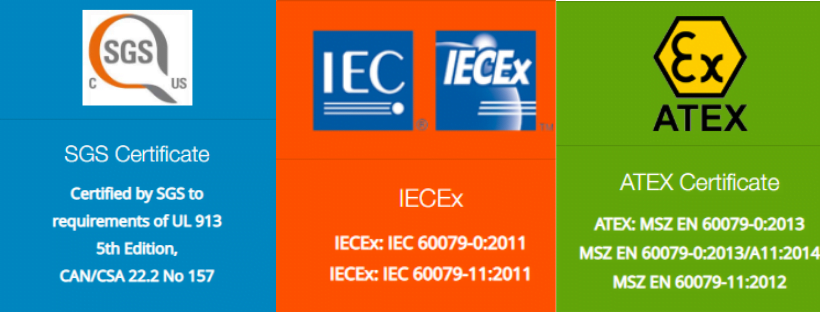
A key difference lies in the certification process. IECEx strictly requires third-party certification from an approved IECEx Certification Body (ExCB). In contrast, for ATEX Zone 2/22 (lower risk) equipment, manufacturers can self-declare conformity. The NEC requires approval and listing by a Nationally Recognized Testing Laboratory (NRTL) like UL or FM, with final sign-off often required from the local Authority Having Jurisdiction (AHJ).
How to Choose the Right Certification for Your Project
Selecting the correct certification is critical and depends entirely on your project’s geography and market. Here are the key factors to consider:
- Target Market: Where will the final product be installed and operated? If it’s in the EU, ATEX is non-negotiable. For the US, you must comply with NEC standards and obtain an NRTL mark. For projects in Asia, Australia, or other international markets, IECEx is often the preferred or required standard.
- Global Strategy: If your company operates globally, specifying equipment with dual ATEX and IECEx certification is a common and efficient strategy. Many products, like those found in the Intrinsically Safe Store, carry multiple certifications to serve a wider market.
- Supply Chain and MRO: Consider the availability of maintenance, repair, and operations (MRO) support. Using equipment certified for a specific region ensures that replacement parts and qualified technicians are readily available.
If you are unsure which certification your application requires, it is essential to consult with an expert. Our team can help you navigate the complexities of hazardous area standards.
Frequently Asked Questions (FAQs)
Can I use an ATEX-certified product in the USA?
No, not directly. The United States operates under the NEC and requires equipment to be listed by a Nationally Recognized Testing Laboratory (NRTL) like UL, FM, or CSA. An ATEX certification alone is not recognized by US authorities (AHJs). The product must have the appropriate North American certification mark.
Is IECEx certification superior to ATEX?
Neither is inherently superior; they serve different purposes. IECEx is an international scheme focused on standardized testing, making it a