Intrinsically Safe Products
Explosion Proof Exhaust Fans | Class 1 Div 1 Certified | ISS
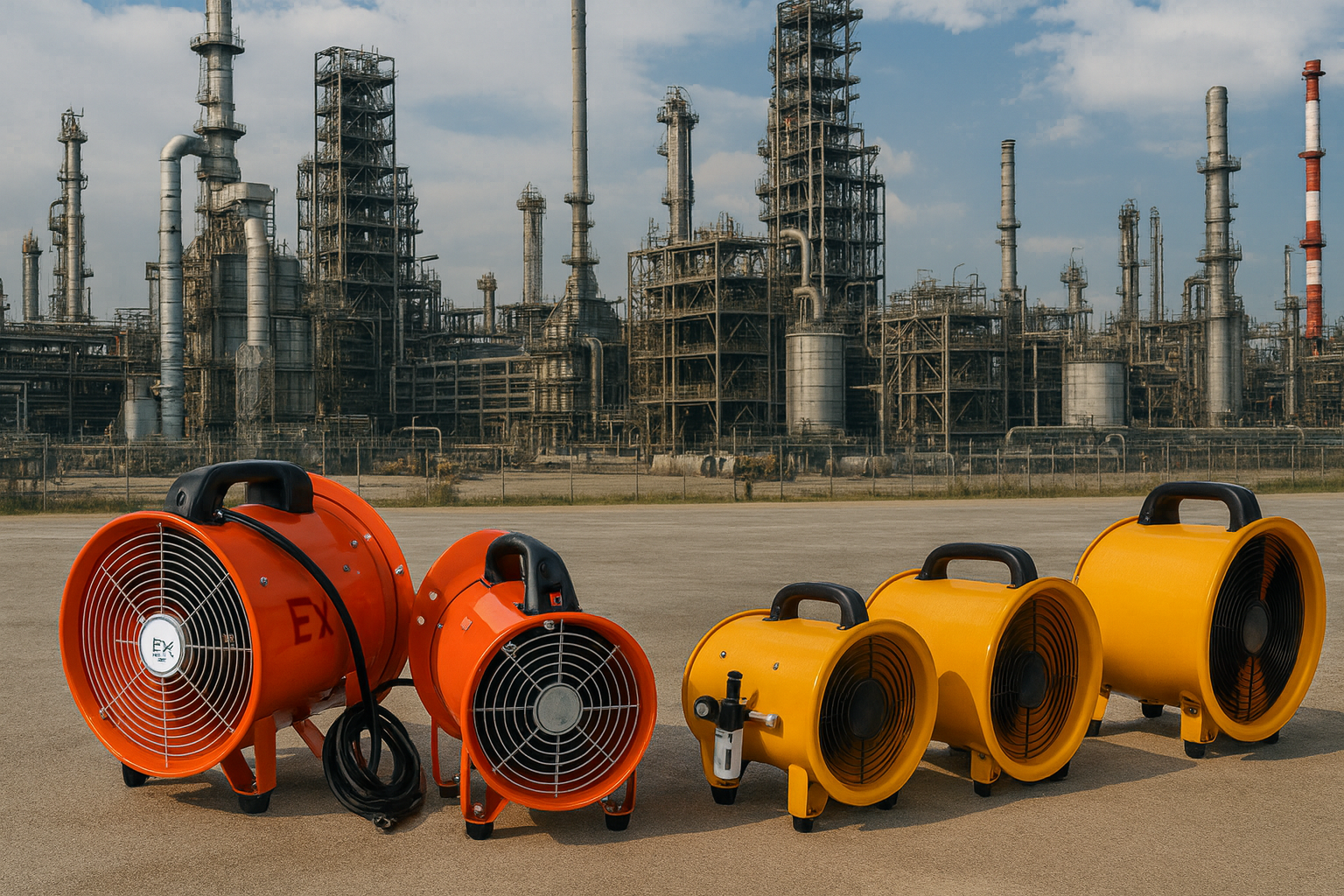
Industrial environments that contain combustible gases, vapors, or dusts rely heavily on properly engineered ventilation systems. One of the most essential components of this system is the explosion proof exhaust fan, built to safely move air while preventing the ignition of hazardous atmospheres. From oil refineries to chemical storage rooms and paint booths, these fans help facilities meet strict safety standards while maintaining compliance with ATEX, IECEx, NEC, and NFPA regulations.
This guide explains everything you need to know about explosion-proof exhaust fans: airflow sizing, hazardous location certifications, Ex ratings, fan materials, installation considerations, and how to select the right model for your environment. Whether you’re an engineer, safety manager, or procurement leader, this article equips you with the knowledge to make a confident, compliant decision.
Shop Certified Explosion-Proof Exhaust Fans
Explore compliant exhaust solutions for hazardous areas and request pricing with confidence.
What Is an Explosion-Proof Exhaust Fan?
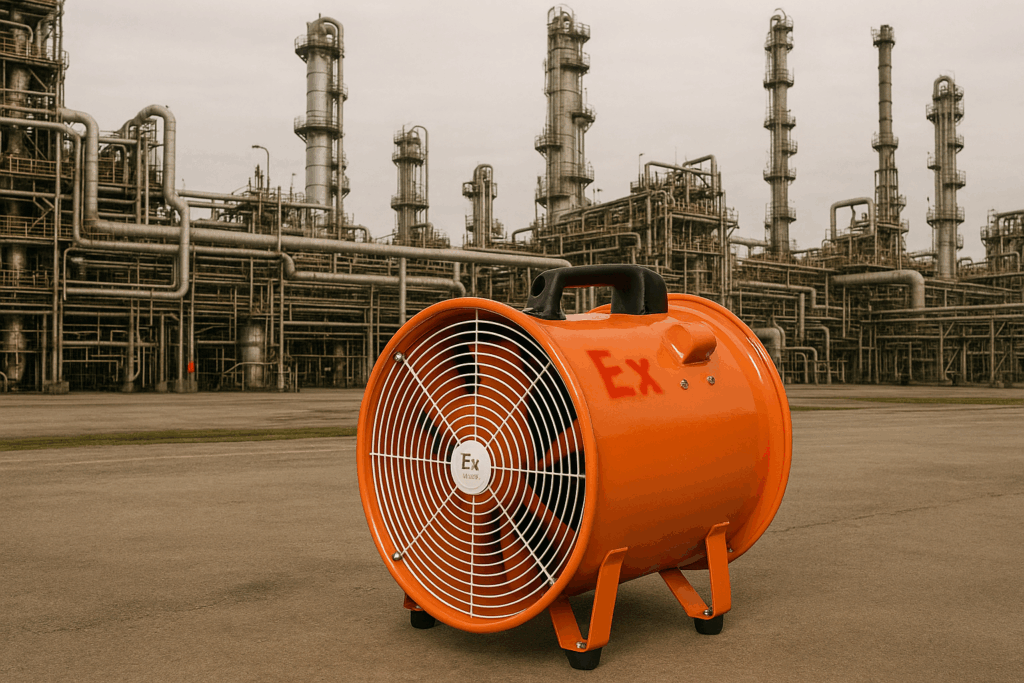
An explosion-proof exhaust fan is a mechanical ventilation device designed so that any internal sparks, heat, or electrical faults cannot ignite flammable substances in the surrounding environment. These fans use sealed housings, non-sparking materials, flameproof motors, and heavy-duty wiring to contain ignition sources while continuously removing hazardous air.
Explosion-proof fans are required in industries such as:
-
Oil & gas
-
Chemical manufacturing
-
Grain handling and milling
-
Battery charging rooms
-
Paint and coatings
-
Pharmaceuticals
-
Wastewater treatment
Explosion-proof does not mean the fan can withstand an external explosion. Instead, it means the fan will not contribute to one.

How Does an Explosion-Proof Exhaust Fan Work?
An explosion-proof exhaust fan reduces combustible concentrations by pulling contaminated air out of a room and replacing it with clean air from a safer source. The key difference from standard fans is the flameproof design, which prevents internal ignition sources from interacting with the ambient atmosphere.
Key engineering features include:
-
Sealed or flameproof motor housings
-
Non-sparking fan blades (aluminum, copper, composite)
-
Heavy-gauge, corrosion-resistant housings
-
Shaft seals to prevent fume ingress
-
Bonding and grounding paths
These features ensure the fan is safe for use in areas where gases, vapors, or dusts may be present at hazardous levels.
Certifications & Ratings for Explosion-Proof Exhaust Fans
What Certifications Should an Explosion-Proof Exhaust Fan Have?
The correct certification ensures the fan complies with hazardous location requirements in your region. The major systems include:
ATEX Certification (European Union)
ATEX applies to equipment used in explosive atmospheres under Directive 2014/34/EU.
Equipment groups:
-
Group I: Mining
-
Group II: Surface industries
Equipment categories correspond to area type:
-
Zone 0 / 1 / 2 for gases
-
Zone 20 / 21 / 22 for dusts
An ATEX-rated fan will carry markings like:
II 2G Ex d IIB T4 Gb
IECEx Certification (International)
IECEx is a globally recognized system ensuring consistent safety standards. It offers equivalent protection to ATEX but is easier to apply internationally since it uses a unified testing scheme.
IECEx markings resemble ATEX, including:
-
Explosion protection method (Ex d, Ex e, etc.)
-
Gas or dust group
-
Temperature class
-
Equipment protection level
North American NEC/CEC Hazardous Location Ratings
The NEC and CEC classify hazardous environments using:
-
Class I – Gases and vapors
-
Class II – Dusts
-
Class III – Fibers
And:
-
Division 2 – Hazard present occasionally
Example:
Class I, Division 1, Groups C & D
To ensure compliance, the fan’s certification must be suitable for the Class, Division, and Group (or Zone and Group) classification of the installation site, as determined by a hazardous area assessment based on standards like NFPA 497 or IEC 60079-10.
Confirm Your Rating, Then Choose the Right Fan
Share your zone/class and room details—our team can help you validate compliance and airflow sizing.
What Do Ex Ratings Mean on an Explosion-Proof Exhaust Fan?
Each Ex marking describes how the fan prevents ignition. Common designations include:
| Ex Code | Meaning |
|---|---|
| Ex d | Flameproof enclosure |
| Ex e | Increased safety |
| Ex nA | Non-sparking construction |
| Ex tD | Protection for dust atmospheres |
| T1–T6 | Maximum surface temperature rating |
T-ratings indicate the maximum temperature any external component can reach.
Example: T4 → max 135°C surface temperature
The fan's temperature class (T-rating) indicates the maximum surface temperature it can reach. Per standards like NEC 500.8(C), this temperature must be safely below the autoignition temperature of the specific hazardous substances in the atmosphere. For example, a T4-rated fan (max 135°C) is suitable for an environment with a substance that ignites at 200°C.
Airflow Requirements: How Much CFM Do You Need?
How Do You Calculate the Required Airflow for a Hazardous Location?
Airflow for an explosion-proof exhaust fan is measured in CFM (cubic feet per minute). To calculate CFM, start with the room’s volume and required air changes per hour (ACH).
CFM = (Room Volume × ACH) ÷ 60
Example
Room size: 30 ft × 20 ft × 10 ft
Room volume: 6,000 ft³
Recommended ACH for a solvent mixing room: 20 ACH
CFM = (6,000 × 20) ÷ 60 = 2,000 CFM
Air change per hour (ACH) requirements are mandated by standards specific to the application, such as NFPA 30 for flammable liquid storage or OSHA guidelines for spray booths. These standards define the necessary ventilation rates to maintain combustible concentrations below the Lower Explosive Limit (LEL). Always consult the relevant, current standards and a qualified engineer to determine the precise ACH for your facility.
Selection Criteria: What to Look for When Choosing an Explosion-Proof Exhaust Fan
What Features Matter Most When Selecting an Explosion-Proof Exhaust Fan?
Choosing the right fan requires evaluating both the hazardous environment and the mechanical performance of the fan. Key considerations include:
-
Correct hazardous location certification (ATEX/IECEx/NEC)
-
Airflow capacity (CFM) and static pressure
-
Motor type (explosion-proof, TEFC, flameproof)
-
Fan material (stainless steel, aluminum, spark-resistant composite)
-
Corrosion resistance
-
Ingress Protection (IP rating)
-
Mounting orientation (wall, roof, inline)
-
Energy efficiency and speed control capability
Features such as permanently lubricated bearings and sealed housings can help reduce maintenance intervals in demanding environments.
How Do Materials Affect Safety and Performance?
Materials must withstand corrosive chemicals, moisture, or dust.
| Material | Advantages | Best For |
|---|---|---|
| Stainless Steel | Highly corrosion-resistant | Marine, chemical, wastewater |
| Aluminum | Lightweight, non-sparking | General industrial, indoor ATEX zones |
| Composite/FRP | Corrosion-proof, spark-free | Battery rooms, chlorine rooms |
| Powder-Coated Steel | Economical | Low-corrosion environments |
Material compatibility is critical when handling acids, solvents, or abrasive dusts.
Common Mistakes When Selecting an Explosion-Proof Exhaust Fan
Choosing the right fan is crucial for safety and compliance, but several common pitfalls can lead to an unsafe or inefficient system. Avoiding these mistakes ensures your investment protects your facility and personnel effectively.
1. Undersizing the Fan (Incorrect CFM)
One of the most frequent errors is selecting a fan with insufficient airflow (CFM). This often happens when relying on generic ACH recommendations without considering specific factors like heat load, the rate of fume generation, or room layout. An undersized fan cannot dilute hazardous concentrations fast enough, defeating its primary safety purpose. Always perform a detailed calculation based on your specific process and consult ventilation standards like those from the NFPA.
2. Ignoring Static Pressure
Airflow (CFM) ratings are often advertised for ideal conditions with zero resistance. However, in any real-world installation, elements like ducts, elbows, filters, and louvers create resistance, known as static pressure. Failing to account for this will cause the fan's actual performance to be much lower than its rated CFM. You must calculate the total static pressure of your entire ventilation system and choose a fan curve that delivers the required CFM at that specific pressure.
3. Mismatching Certifications and Environmental Conditions
It is not enough for a fan to be "explosion-proof"; its certification must precisely match the hazard. This includes the correct Class/Division or Zone, the specific gas or dust Group (e.g., Group C, D), and the Temperature (T) rating. Using a fan rated for Class I, Group D in a Group B environment (like hydrogen) is a critical safety violation. Similarly, overlooking material compatibility for corrosive atmospheres can lead to premature failure. A thorough hazardous area analysis is non-negotiable.
Maintenance and Inspection Best Practices
An explosion-proof fan's safety certification is only valid if the unit is properly maintained. Regular inspections are required by standards like NFPA and OSHA to ensure the protective features remain intact. A proactive maintenance schedule prevents failures and maintains compliance.
Routine Visual and Auditory Checks (Monthly/Quarterly)
Regular, simple checks can identify developing issues before they become critical. Personnel should listen for unusual noises like rattling or grinding, which could indicate bearing failure or a loose component. Visually inspect for:
- Corrosion on the housing, blades, or fasteners.
- Build-up of dust, debris, or product residue on the fan blades and guards, which can unbalance the fan and reduce airflow.
- Integrity of all guards and screens.
Detailed Mechanical and Electrical Inspections (Annually)
A qualified technician should perform a comprehensive annual inspection. This includes:
- Bearing Lubrication: Follow the manufacturer's guidelines for lubricating bearings. Over- or under-lubrication can cause premature failure.
- Blade and Housing Integrity: Check for cracks, warping, or excessive wear on the fan blades. Ensure the gap between the blade tips and the housing is within the manufacturer's specified tolerance to prevent sparking.
- Electrical Connections: Verify that all electrical connections are tight and corrosion-free. Critically, check the integrity of the grounding and bonding connections, as these are essential for dissipating static electricity.
- Seals and Gaskets: Inspect all seals and gaskets on the motor housing and any junction boxes to ensure they are not cracked or degraded, which would compromise the flameproof enclosure.
Installation Considerations
How Do Installation Conditions Affect an Explosion-Proof Exhaust Fan?
Even the best fan will not perform correctly if poorly installed. Key factors include:
-
Duct length and number of elbows – Reduce static pressure loss
-
Fan placement relative to fume source – Reduces buildup
-
Ambient temperature – Must match motor rating
-
Structural support – Prevents vibration and misalignment
-
Grounding and bonding – Required by NEC and ATEX
-
Access for maintenance – Ensures compliance inspections
Roof penetrations, wall openings, and duct transitions must be sealed to maintain hazardous area boundaries.
Types of Explosion-Proof Exhaust Fans
Wall-Mounted Explosion-Proof Fans
Simple installation, best for smaller rooms and direct-to-outside airflow.
Roof-Mounted Explosion-Proof Fans
Ideal for high-volume airflow or vertical discharge requirements.
Inline Explosion-Proof Duct Fans
For long duct runs or applications needing isolated motor placement.
Comparison Table: Explosion-Proof Exhaust Fan Types
| Feature | Wall-Mount EX Fan | Roof-Mount EX Fan | Inline EX Duct Fan |
|---|---|---|---|
| Airflow Capacity | Medium | High | Medium–High |
| Certifications | ATEX/IECEx/NEC | ATEX/IECEx/NEC | ATEX/IECEx |
| Installation Difficulty | Low | Moderate | High |
| Maintenance Access | Easy | Requires roof access | Motor may be remote |
| Best For | Battery rooms, mixing rooms | Paint booths, large facilities | Pharmaceutical, chemical ducts |
Best By Industry
-
Oil & Gas: Inline or wall-mount
-
Chemical Processing: Roof-mounted high-volume units
-
Battery Rooms: Wall-mounted composite systems
-
Grain Handling: Heavy-duty dust-rated fans
-
Paint Booths: High-capacity roof exhaust
Complete Your Hazardous Ventilation Setup
Pair certified airflow with the right motor and portable detection for stronger risk control.
Frequently Asked Questions (FAQs)
What is the difference between intrinsically safe and explosion-proof?
Explosion-proof equipment contains ignition sources within flameproof housings, while intrinsically safe equipment limits electrical energy so ignition cannot occur. Fans must be explosion-proof, not intrinsically safe.
Can I use a standard fan in a hazardous location?
No. Standard fans can create sparks, static discharge, or hot surfaces, all of which can ignite flammable atmospheres. Only certified explosion-proof models are compliant.
How often should explosion-proof fans be inspected?
Most industrial sites inspect visually every 90 days and perform detailed checks annually, including bearing lubrication, seal condition, and electrical continuity.
Are explosion-proof fans louder?
They often are, due to heavy-duty motors and enclosures. However, modern EX fans increasingly incorporate noise-reduction designs.
Do explosion-proof fans replace gas detectors?
No. Ventilation complements detection systems but does not eliminate the need for monitoring.
Conclusion: How to Choose the Right Explosion-Proof Exhaust Fan
Selecting the correct explosion proof exhaust fan requires understanding your hazardous area classification, airflow needs, environmental conditions, and installation requirements. By matching certifications to your zone or class/division, calculating correct CFM, choosing corrosion-resistant materials, and planning proper installation, you create a safer, compliant, and more efficient facility.
For certified devices used in hazardous environments—including communication tools, cameras, detectors, and more—explore the Intrinsically Safe Store.