




















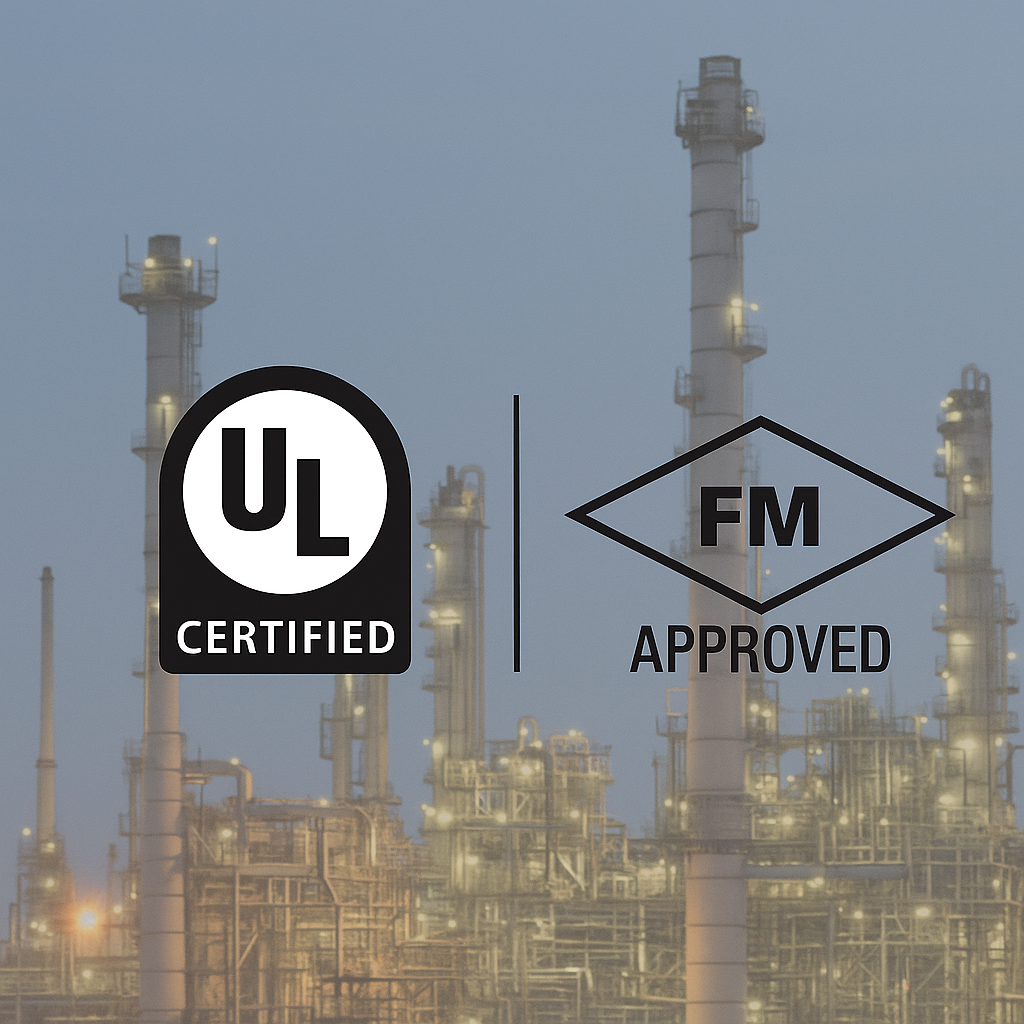
When operating in hazardous locations, intrinsic safety certifications like UL and FM approval are more than just compliance checkboxes—they’re lifelines. In environments where flammable gases, dust, or vapors are present, using the wrong equipment could result in catastrophic explosions or fires. That’s why certifications like FM Approved intrinsically safe are crucial.
This article unpacks the distinctions between UL and FM certifications, explores how each applies to intrinsically safe equipment, and guides you on selecting the right certification for your industrial needs.
What Does “FM Approved Intrinsically Safe” Really Mean?
FM Approved intrinsically safe equipment has been tested and certified by FM Approvals, an internationally recognized testing lab affiliated with FM Global (an industrial insurance company). FM evaluates whether a product will not cause ignition in hazardous environments even under fault conditions.

Key Components of FM Approval:
Tested under FM 3610 standard for intrinsic safety
Verifies that energy levels are kept below ignition thresholds
Considers both normal and abnormal operating conditions
Validates design, materials, and environmental durability
FM certification applies across a wide range of industries:
Oil and Gas: Refineries, platforms, and pipelines
Chemical Plants: Processing and mixing zones
Mining: Tunnels, shafts, and ventilation systems
Grain Storage and Agriculture: Dust-heavy operations
Utilities: Gas meter installations and substations
What FM Approval Signifies:
Confidence for insurers and auditors
Validity for Class I, II, III / Division 1 and 2 or Zone 0, 1, 2
Reduced liability in case of fire or explosion
What is UL Certification and What Makes It Unique?
UL (Underwriters Laboratories) is a nonprofit safety certification company that evaluates electrical devices, systems, and components. Its standard UL 913 governs intrinsically safe apparatus for hazardous locations.
What UL Certification Includes:
Evaluation for ignition protection in flammable atmospheres
Testing of electrical faults, enclosure strength, and energy limits
Compliance with National Electrical Code (NEC) Article 504
Focus on product safety during both normal use and failure modes
UL is often the go-to for:
Consumer-grade explosion-proof devices
Portable instruments used in industrial inspections
OEM components used in hazardous-area-certified assemblies
FM vs UL: Shared Standards, Different Approaches
Though UL and FM both certify for intrinsic safety, they approach testing differently:
| Feature | UL Certification | FM Approval |
|---|---|---|
| Testing Focus | Product-level functionality | Holistic risk reduction approach |
| Standard Applied | UL 913, ANSI/ISA 60079 | FM 3610, ANSI/ISA 60079 |
| Safety Philosophy | Prevent electrical faults | Prevent ignition under fault conditions |
| Acceptance by Insurers | Moderate | High |
| NRTL Recognition (OSHA) | Yes | Yes |
| Product Labeling | “UL Listed” or “UL Recognized” | FM Diamond Logo |
| International Alignment | Often paired with IECEx or ATEX | Common in North America |
While the standards themselves overlap (both referencing IEC 60079 and ANSI/ISA guidelines), FM places heavier emphasis on environmental stress testing and insurance risk mitigation, while UL focuses more on electrical hazard protection.
Why Dual Certification Is the Gold Standard
In high-risk industries, many devices carry both FM and UL approvals. This dual certification simplifies cross-functional deployment, meets insurance requirements, and expedites approval from engineering or safety teams.
Dual Certification Benefits:
Meets OSHA and NFPA 70 (National Electrical Code) mandates
Smooths internal procurement and compliance processes
Helps gain entry into international markets (especially with ATEX + IECEx)
Example:
The Sonim XP10 IS smartphone is FM Approved, UL Certified, PTCRB validated, and FirstNet Ready™—making it ideal for cross-industry deployment in hazardous zones.
Regulatory Context: Where FM and UL Fit In
Intrinsic safety certifications must align with government standards. In the U.S., both UL and FM are NRTLs (Nationally Recognized Testing Laboratories) designated by OSHA.
Regulatory Standards Reference:
| Regulatory Body | Relevant Code/Standard | Role in Intrinsic Safety |
|---|---|---|
| OSHA | 29 CFR 1910.307 | Requires certified equipment in hazardous locations |
| NEC (NFPA 70) | Articles 500–506 | Defines hazardous (classified) locations |
| ANSI/ISA | 60079 series | U.S. adaptation of IEC standards |
| IECEx / ATEX | IEC/EN 60079 | Global intrinsic safety standards |
What Products Require FM or UL Certification?
Intrinsic safety certification is required for any electrical device used in hazardous (classified) locations, including:
Mobile devices (smartphones, tablets, radios)
Lighting (flashlights, headlamps)
Control panels
Browse FM Approved Intrinsically Safe Devices to ensure your tools are certified for the job.
How Do I Identify Certified Equipment?
FM Certification Label Includes:
Diamond FM logo
Class/Division or Zone information
Temperature rating (e.g., T4)
Approval number for verification
UL Certification Label Includes:
UL Listed mark
Class/Division or Zone
File number traceable on UL’s database
You should never deploy uncertified equipment in hazardous environments. Doing so can:
Void insurance policies
Trigger safety violations during audits
Endanger worker lives
Practical Considerations When Choosing Certification
Consider FM Approved Intrinsically Safe Devices If:
You’re in the oil, gas, or petrochemical industry
Your insurer requires FM-certified equipment
You operate in Class I, Division 1 or Zone 0 environments
Environmental stress resistance is critical
Consider UL Certified Devices If:
You’re in manufacturing, logistics, or field service
You need rapid approval and broad compatibility
You’re deploying equipment in non-ATEX regulated countries
You value cost-effective compliance
In most cases, dual certification ensures flexibility and simplifies vendor procurement.
Still unsure what to choose? Talk to a Safety Expert →
Frequently Asked Questions (FAQs)
Are UL and FM certifications interchangeable?
Not exactly. While both are accepted in North America, some insurers or safety managers may require FM specifically due to its insurance-based origin. It’s best to check your site’s safety requirements.
Can a product be sold with only one of the certifications?
Yes. A product can be sold with only FM or only UL approval. However, dual certification is increasingly common for industrial buyers who need maximum flexibility and compliance.
Is one certification more rigorous than the other?
FM testing is often considered more exhaustive for high-liability environments due to its insurance lineage, but both certifications are valid and OSHA-recognized.
Do I need these certifications outside the U.S.?
For operations outside North America, look for ATEX (EU) and IECEx (global) certification. However, many products carry all four certifications—UL, FM, ATEX, and IECEx—for international use.
Where can I verify a product’s FM or UL status?
FM: Visit FM Approvals
UL: Use the UL Product iQ database
Product Comparison Table
| Device | Certification | Best For | Key Features | Intrinsic Rating |
|---|---|---|---|---|
| Ecom Smart-Ex® 02 DZ1 | FM, UL, ATEX | Oil & Gas, Chemical | Rugged Android, Push-to-Talk | Class I, Div 1, Zone 1 |
| Sonim XP10 IS | FM, UL, PTCRB | Field Inspection, Utilities | 5G Ready, Touchscreen + Physical Keys | Class I, Div 2 |
| Aegex10 IS Tablet | FM, UL, ATEX | Data Logging, Industrial IoT | Windows OS, Wi-Fi, Bluetooth | Zone 1/21 |
| i.safe MOBILE IS530.1 | FM, IECEx, ATEX | Logistics, Chemical | Scanner, Loud Speaker, Camera | Class I, Div 1 |
Final Thoughts: Choosing Between FM and UL Certification
In summary, UL and FM certifications serve the same goal—preventing ignition in hazardous environments—but offer different strengths. FM is preferred in high-risk and insurance-driven contexts, while UL is widely accepted and offers fast, reliable product certification.
When shopping for FM Approved intrinsically safe equipment, consider:
Your hazardous classification (Class/Division or Zone)
Insurance or regulatory mandates
Your industry-specific risks and usage pattern
