Intrinsically Safe Products
Explosion-Proof Motor Starters | Class I Div 1 Rated | ISS
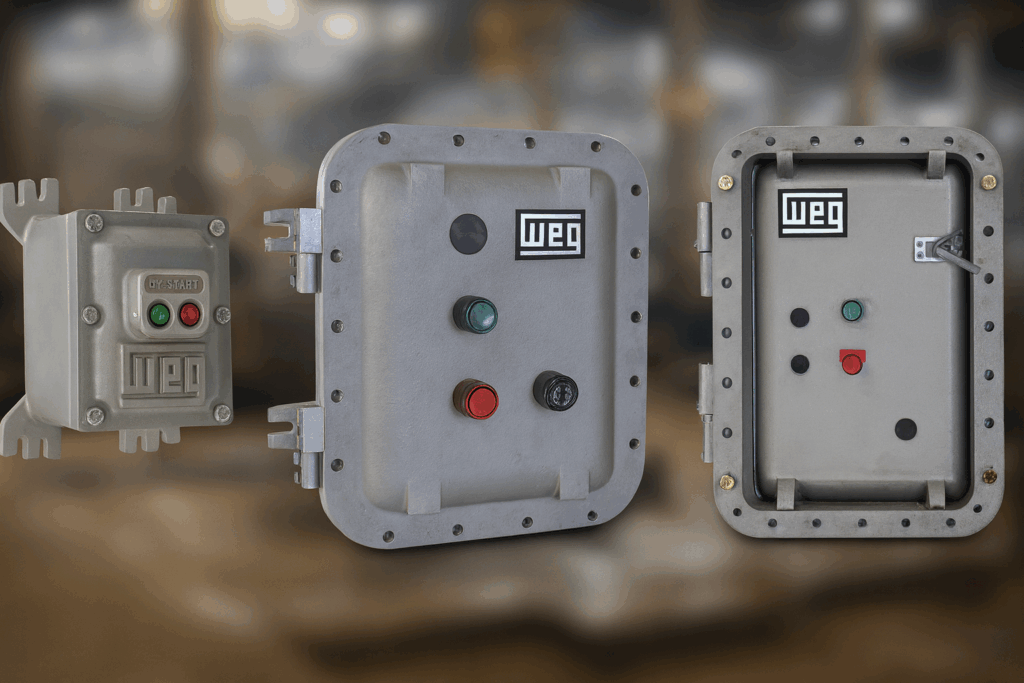
Explosion-proof motor starters play a critical role in industries where flammable gases, vapors, or combustible dusts may be present. These environments require electrical equipment designed to prevent sparks, arcs, or excessive heat from igniting the surrounding atmosphere. This guide explains what an explosion proof motor starter is, how to choose the right type, how certifications apply, how sizing works, and what installation requirements must be followed for compliance and safe operation.
Explosion-proof starters are mandatory in numerous industrial sectors, and proper selection directly impacts safety, operational reliability, and regulatory compliance. Understanding the principles behind protection concepts, enclosure ratings, and motor control methods is essential for any facility operating in hazardous areas.
Proper motor starting begins with a certified enclosure. Find the right flameproof housing to ensure safe operation, effective heat dissipation, and full compliance with ATEX and NEC standards.
What Is an Explosion-Proof Motor Starter?
An explosion-proof motor starter is an electrical device used to start, stop, and protect motors in hazardous locations. These starters are housed inside flameproof enclosures designed to withstand internal ignition events. If a spark or arc occurs during switching, the enclosure contains the explosion and cools escaping gases so they cannot ignite the surrounding atmosphere.
Key Functions of Explosion-Proof Motor Starters
-
Start and stop motor circuits
-
Provide overload and short-circuit protection
-
Prevent ignition of hazardous atmospheres
-
Maintain safe operation during switching activities
Explosion-proof starters typically comply with ATEX, IECEx, UL, CSA, NEC, or CEC requirements depending on where they are used.
Key Components Inside an Explosion-Proof Motor Starter
While the external enclosure provides the primary explosion protection, the internal components manage the motor’s operation. A typical starter includes several critical parts, all designed to function reliably within the sealed housing.
- Contactor: This is an electrically controlled switch that connects and disconnects the motor from the power supply. It is the core component responsible for starting and stopping the motor.
- Overload Relay: This device protects the motor from drawing too much current, which could lead to overheating and damage. It monitors the current and trips the circuit if it exceeds a safe level for a prolonged period.
- Circuit Breaker or Fuses: Provides essential short-circuit protection, interrupting the circuit immediately in the event of a major fault to prevent catastrophic failure.
- Control Transformer: In some starters, a transformer is used to step down the main voltage to a lower voltage (e.g., 24V or 120V) for the control circuit, enhancing safety for operators interacting with start/stop buttons.
- Terminal Blocks: These provide secure connection points for incoming power, outgoing motor leads, and control wiring, ensuring reliable electrical contact.
Each of these components must be rated for the intended voltage and current and arranged within the enclosure to manage heat dissipation effectively.

Why Explosion-Proof Starters Are Required in Hazardous Areas
In hazardous areas, electrical equipment must be designed to eliminate or contain ignition sources. Motor starters inherently produce arcs during operation. Without explosion-proof construction, these arcs could ignite gases, vapors, or dusts present in the environment defined by the area’s hazardous area classification.
Industries That Require Explosion-Proof Motor Starters
-
Oil and gas processing
-
Chemical and petrochemical plants
-
Grain handling and milling operations
-
Mining facilities
-
Pharmaceutical production
-
Fuel storage and distribution
-
Marine and offshore operations
Explosion-proof equipment ensures safe, continuous operation even under fault conditions.
Types of Explosion-Proof Motor Starters
What are the main types of explosion-proof motor starters?
Explosion-proof motor starters come in several configurations depending on motor size, load requirements, and application needs. These include Direct-On-Line (DOL) starters, Star-Delta starters, soft starters, and VFD-based systems. All types can be integrated into flameproof or pressurized enclosures suitable for hazardous areas.
Direct-On-Line (DOL) Starters
DOL starters apply full voltage directly to the motor, making them simple and robust. They are widely used for small and medium motor applications.
Advantages
-
Simple construction
-
Cost-effective
-
Reliable for general-purpose motors
Limitations
-
High inrush current
-
Not ideal for large motors requiring reduced starting torque
Star-Delta Starters
Star-delta starters reduce starting current by initially wiring the motor in a star configuration before switching to delta.
Advantages
-
Reduces electrical stress
-
Suitable for larger motors
-
Minimizes voltage dips
Limitations
-
Requires more internal components
-
More complex wiring inside the enclosure
Explosion-Proof Soft Starters
Soft starters gradually ramp up voltage, reducing mechanical and electrical stress.
Benefits
-
Smooth acceleration
-
Reduces impact on pumps, conveyors, and compressors
-
Minimizes heat shock and water hammer in piping systems
Explosion-Proof VFD Starters
Variable Frequency Drives control motor speed and torque. Because VFDs generate heat, they may require pressurized enclosures or safe-area installation with remote controls.
Best suited for:
-
Pumping systems
-
Compressors
-
Variable-speed conveyors
Your starter is only as effective as the motor it controls. Ensure seamless integration and safety by selecting a motor with the correct hazardous area rating and performance specifications.
Hazardous Area Ratings and Certifications
What certifications should an explosion-proof motor starter have?
Explosion-proof starters must match the hazardous area’s classification. Certification ensures the equipment is tested and verified for operation under defined explosive atmospheres.
Common ATEX/IECEx Marking Example
Ex d IIB T6 Gb
Interpretation:
-
IIB: Gas group
-
T6: Maximum surface temperature of 85°C
-
Gb: Suitable for Zone 1 environments
North American Classification Systems
-
Class I: Gas and vapor environments
-
Class II: Dust environments
-
Division 1: Hazard likely
-
Division 2: Hazard unlikely or intermittent
-
Groups A–G: Specific material classifications
How do ATEX Zones compare to NEC Divisions?
While not a direct one-to-one mapping, the North American Division system can be broadly compared to the IEC Zone system. Class I, Division 1 addresses areas where ignitable concentrations can exist under normal operating conditions, which encompasses the risk levels of both Zone 0 (continuous presence) and Zone 1 (likely presence). Class I, Division 2, where hazards exist only under abnormal conditions, is more closely aligned with Zone 2. It is critical to note that equipment must be specifically certified for the designated Zone or Division; for example, not all Division 1 equipment is suitable for Zone 0.
Understanding classifications ensures proper starter selection for safety and regulatory compliance.
If you’re validating classifications or comparing protection concepts, these guides will help you confirm the right path before specifying equipment.
Sizing an Explosion-Proof Motor Starter
How do you size an explosion-proof motor starter?
Correct sizing ensures reliable performance and avoids nuisance trips or overheating. Sizing depends on full-load current (FLA), operating voltage, duty cycle, enclosure type, and ambient temperature.
Essential Sizing Steps
-
Determine motor full-load current.
-
Select an overload relay adjustable to approximately 115% of FLA.
-
Ensure the short-circuit current rating matches system fault capacity.
-
Choose an enclosure large enough to dissipate heat.
-
Match the certification (Ex d, Ex p, Ex tb) to the area classification.
Explosion-proof enclosures restrict airflow, so proper thermal management is critical.
What environmental factors influence motor starter sizing?
Environmental conditions impact thermal rise, enclosure requirements, and component longevity. Key factors include:
-
High ambient temperature
-
Vibration or mechanical shock
-
Humidity and corrosive atmospheres
-
Dust accumulation
-
Outdoor exposure requiring IP66 or NEMA 4X protection
Thermal rise, enclosure volume, and derating considerations
Explosion-proof housings can trap heat, requiring derating of components or selecting larger enclosures. Proper sizing helps prevent premature failure and ensures safe continuous operation.
Installation Requirements for Explosion-Proof Motor Starters
What are the key installation rules in hazardous areas?
Installation must preserve the enclosure’s certification and maintain flameproof integrity. All components, fittings, and accessories must be certified for the hazardous area classification.
Cable entry and gland requirements
-
Only certified Ex d, Ex e, or Ex tb glands may be used
-
Barrier glands required with flexible cables
-
Adapters and reducers must also be certified
-
Cable outer sheath must match environmental conditions
Conduit and sealing fittings
For NEC and CEC installations:
-
Seal-off fittings must be installed within required distances
-
Sealing compounds must fully fill the fitting
-
Rigid metal conduit is usually required
-
Bonding continuity must be maintained
Earthing and bonding
Proper grounding prevents static discharge and ensures safe fault clearing.
Requirements include:
-
External and internal grounding terminals must be used
-
Armored cable bonding continuity
-
Equipotential bonding for conductive structures
Temperature classification and mounting
-
Verify T-rating compatibility with ambient conditions
-
Maintain clearance from heat sources
-
Provide adequate space for air circulation
-
Ensure mounting surfaces can withstand enclosure weight
Ingress protection (IP/NEMA) considerations
-
IP66/IP67 or NEMA 4X for washdown or outdoor environments
-
Glands must preserve enclosure ingress rating
-
Corrosion-resistant materials may be required
Internal spacing and wiring layout
-
Maintain minimum creepage and clearance distances
-
Do not overcrowd internal components
-
Ensure wiring does not obstruct flame paths
Local vs. remote starter placement
-
Local starters suitable for Zone 1/Div 1 environments
-
Large motors may place starters in safe areas with remote controls
-
VFDs often require pressurized (Ex p) enclosures
Inspection and maintenance requirements
Explosion-proof motor starters must undergo periodic inspections per IEC 60079-17 and NFPA 70B, including:
-
Flame path condition
-
Tightening of bolts and cable glands
-
Gasket integrity
-
Corrosion and environmental damage
-
Label visibility and certification markings
Comparison Table: Explosion-Proof Motor Starter Types
| Feature / Type | Ex DOL Starter | Ex Star-Delta Starter | Ex Soft Starter |
|---|---|---|---|
| Certifications | ATEX/IECEx, Class I Div 1 | ATEX/IECEx | ATEX/IECEx (often Ex p) |
| Best For | Small–medium motors | Larger induction motors | Smooth acceleration needs |
| Starting Current | High | Moderate | Low |
| Complexity | Low | Medium | Medium–High |
| Heat Generation | Moderate | High | High |
| Common Applications | General industry | Water treatment, refining | Pumps, compressors |
Recommended Equipment Categories
Explosion-proof motor starter systems often incorporate:
-
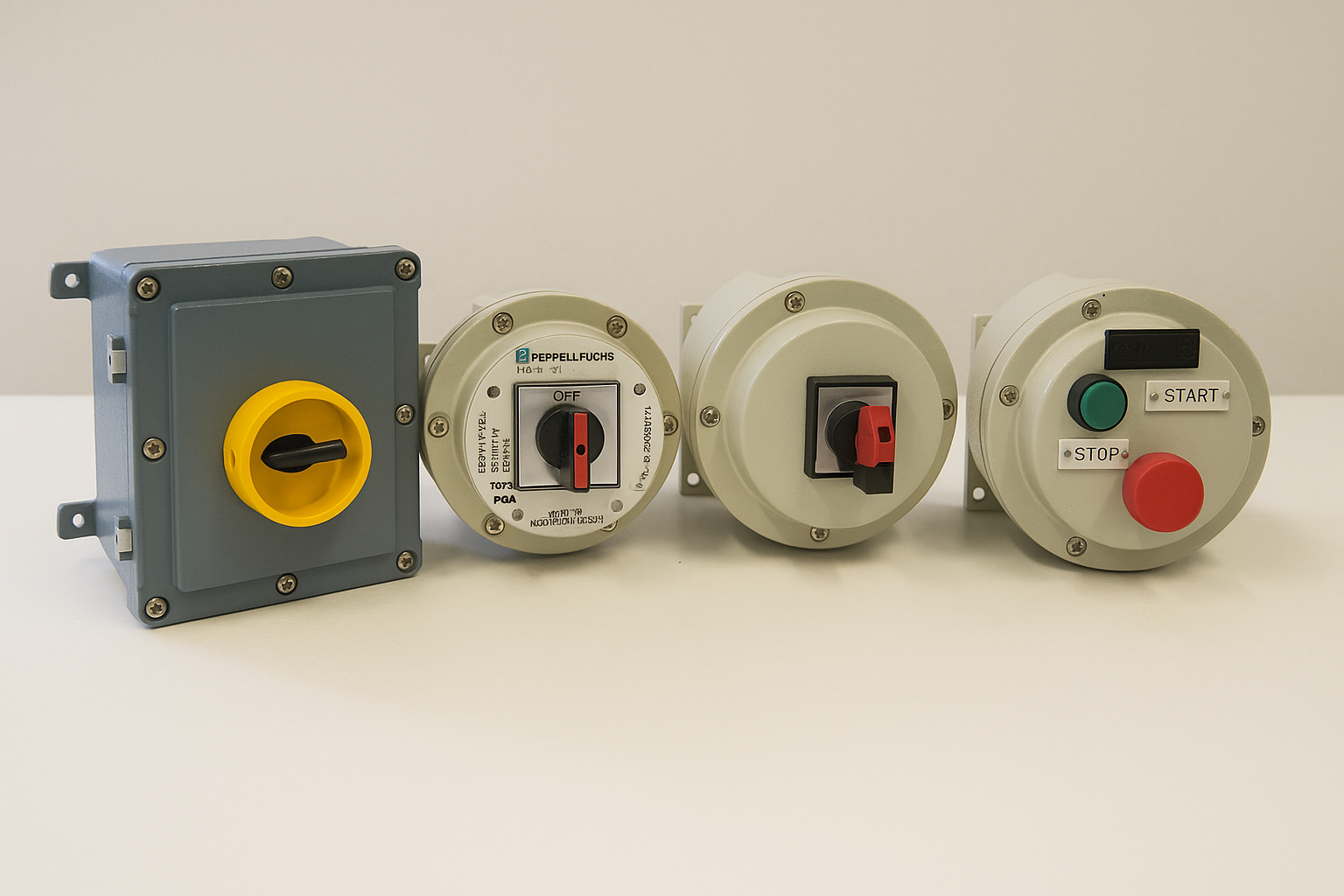
Explosion-proof control stations
-
Explosion-proof disconnect switches
-
ATEX junction boxes and cable glands
These components support compliant, safe motor starter assemblies in hazardous areas.
Industry-Based Selection Guide
| Industry | Best Motor Starter Type | Reason |
|---|---|---|
| Oil and Gas | Ex d DOL or Star-Delta | High reliability and flameproof safety |
| Chemical Processing | Ex d Soft Starter | Smooth acceleration minimizes process impact |
| Mining | Heavy-duty Ex d DOL | Robustness against vibration and dust |
| Food and Grain | Ex tb Starter | Suitable for combustible dust environments |
| Water/Wastewater | VFD with Ex p | Ideal for pump speed control |
Selecting the right components can be complex. Our specialists can help you build a complete, quote-ready assembly, including starters, junction boxes, and barriers, tailored to your specific application.
FAQs About Explosion-Proof Motor Starters
Are explosion-proof starters the same as intrinsically safe equipment?
No. Intrinsically safe (IS) equipment limits electrical energy, while explosion-proof (Ex d) equipment contains ignition inside a flameproof enclosure. Motor starters require more energy than IS design permits.
Can a standard motor starter be used in a safe area with cables running into a hazardous area?
Yes, but only if all wiring methods, seals, and motor terminal equipment meet hazardous-area requirements. The starter itself must remain in a non-classified location.
Do explosion-proof motor starters need regular maintenance?
Yes. Flame paths, gaskets, torque values, and cable glands must be inspected periodically in accordance with IEC 60079-17 and NFPA 70B.
Can VFDs be certified explosion-proof?
VFDs generate significant heat and typically require Ex p pressurization or installation in a safe area with remote control interfaces.
Does the starter need the same gas group rating as the motor?
Yes. All equipment in the hazardous area must match or exceed the location’s gas or dust group classification.
Conclusion
Choosing the correct explosion proof motor starter is essential for ensuring safety, compliance, and operational reliability in hazardous environments. Understanding protection concepts, hazardous-area classifications, starter types, sizing methods, and installation rules enables organizations to design safer electrical systems and reduce ignition risks. With proper equipment selection and adherence to installation standards, explosion-proof motor starters provide long-term protection and dependable performance in challenging industrial environments.