






















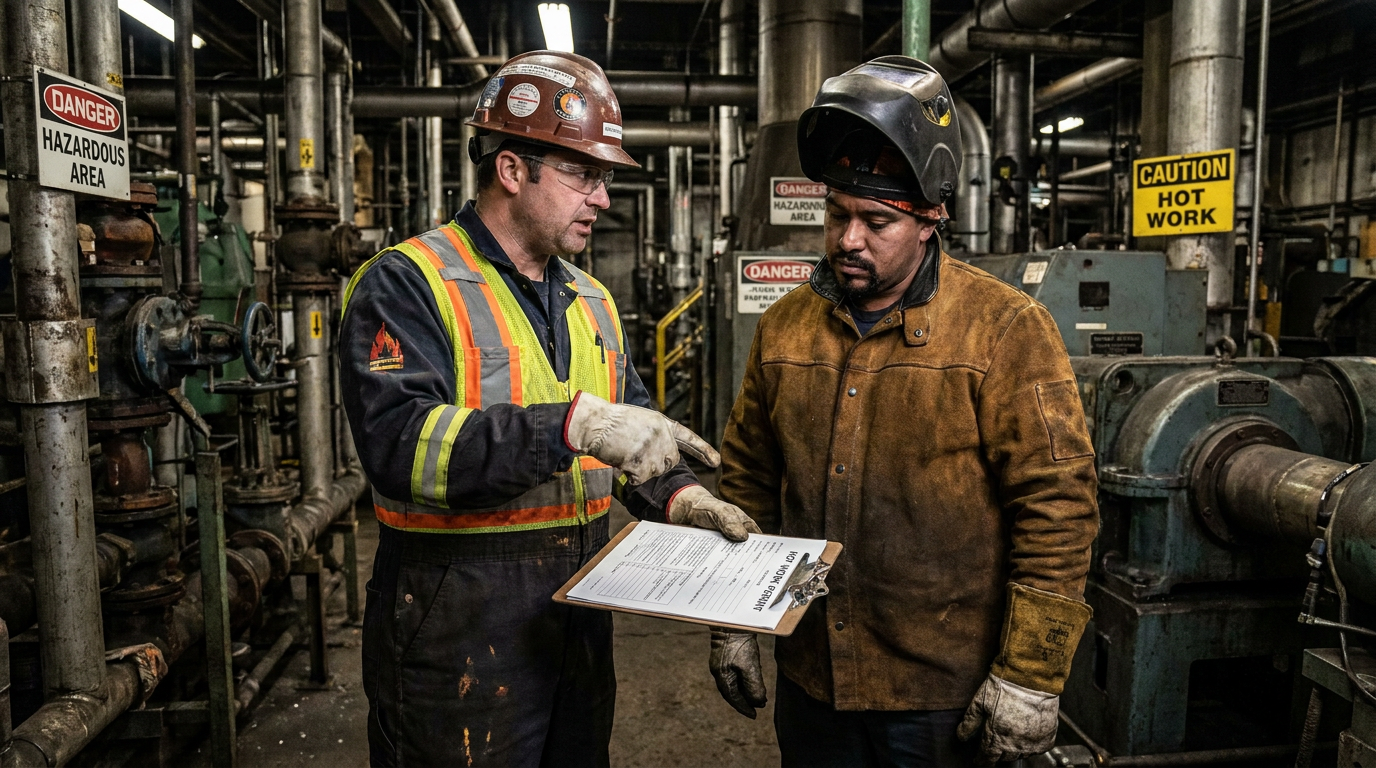
Navigating the complexities of industrial safety requires a deep understanding of risk, especially when high-energy activities meet potentially volatile environments. Among the most high-stakes operations are those involving “hot work”—any process that can produce a source of ignition, such as welding, cutting, grinding, or even using certain types of non-intrinsically safe electronics. When this work must be performed in a “classified” or “hazardous” area—an environment where flammable gases, vapors, liquids, or combustible dusts are present—the potential for a catastrophic event multiplies exponentially. A single spark in the wrong place at the wrong time can lead to devastating fires and explosions, threatening lives, destroying assets, and causing irreparable environmental damage. This is precisely why a robust and meticulously executed Hot Work Permit system is not just a piece of administrative paperwork; it is a critical, life-saving procedure that serves as the backbone of operational safety in these demanding settings. The permit is a formal communication tool, a risk assessment document, and a step-by-step safety agreement all rolled into one, ensuring that every conceivable precaution has been identified, implemented, and verified before the first spark ever flies. This comprehensive guide will walk you through every phase of that process, providing the detailed checklists and expert insights needed to master this essential safety discipline.
Explore Our Comprehensive Industrial Safety Resource Library
Stay updated on the latest hazardous area regulations, safety protocols, and compliance frameworks. Access our deep-dive articles written by industrial compliance experts.
Browse the Knowledge HubThe Definitive Hot Work Permit Process Checklist for Hazardous Areas
A successful hot work permit program is built upon a systematic and non-negotiable checklist. This process ensures that all stakeholders, from management to the operator performing the task, are aligned on the risks and the controls needed to mitigate them. The checklist should be treated as a sequential guide, with each step being fully completed and verified before moving to the next.
Phase 1: Pre-Work Risk Assessment and Planning
- Question the Necessity of Hot Work: The very first and most important step is to determine if the hot work is absolutely unavoidable. Can the job be completed using a cold work method?
- Comprehensive Site and Task Analysis: If hot work is deemed essential, a thorough risk assessment must be conducted by a team of competent individuals.
- Define Roles and Responsibilities: Clearly identify and assign key personnel.

Phase 2: On-Site Preparation and Hazard Control (Pre-Work Execution)
- Isolate and Depressurize Equipment: The specific equipment or piping to be worked on must be completely isolated from any process materials.
- Secure the 35-Foot (11-Meter) Zone: The area within a 35-foot radius of the hot work must be cleared of all combustible and flammable materials.
- Seal Potential Leak Paths: Pay meticulous attention to the floor and surrounding structures.
- Atmospheric Testing: A calibrated multi-gas detector must be used by a trained person to test the atmosphere in the work area.
Equip Your Safety Teams with Certified Gas Detection Systems
Eliminate risk before initiating any hot work procedure. Deploy rugged, intrinsically safe portable gas detectors designed to accurately monitor explosive vapors and hazardous atmospheres in real-time.
View Portable Gas DetectorsHot Work Permit Framework: Standard vs. Hazardous Areas
| Safety Parameter | Standard Hot Work Area | Classified / Hazardous Area |
|---|---|---|
| Primary Safety Focus | Controlling and removing local combustible materials (fuel source management). | Absolute elimination of ignition sources; continuous management of volatile atmospheres. |
| Atmospheric Testing | Rarely required unless adjacent to confined spaces or chemical storage. | Mandatory pre-work testing and continuous monitoring with calibrated multi-gas detectors (0% LEL target). |
| Permit Duration | May cover the duration of a specific project or multiple consecutive shifts. | Strictly limited to a single shift (8–12 hours); completely voided during unexpected process disruptions. |
| Isolation Protocols | Basic physical screening and moving flammable objects 35 feet away. | Complex process isolation (e.g., double block and bleed), sealing floor drains, and depressurizing equipment lines. |
| Fire Watch Protocol | Assigned based on nearby fire risks; standard monitoring during work. | Mandatory dedicated personnel with no alternating duties; required to monitor for at least 60 minutes post-execution. |
Frequently Asked Questions
What is the fundamental difference between a standard hot work permit and one for a classified area?
While both permits are designed to prevent fires, a permit for a classified (hazardous) area operates on a much higher level of stringency due to the ever-present potential for an explosive atmosphere. A standard hot work permit, used in an area like a general fabrication shop, primarily focuses on controlling nearby combustible materials (the “fuel” side of the fire triangle). A classified area permit, however, must assume the “fuel” (flammable gas, vapor, or dust) is already present or could be introduced at any moment. Therefore, its primary focus is on the absolute, verifiable elimination of the “ignition source” and the continuous monitoring of the atmosphere to ensure it remains non-explosive. This involves mandatory and often continuous gas detection, complex equipment isolation procedures like double block and bleed, and a much more rigorous assessment of how process conditions could change and impact the work area.
Who is actually authorized to issue a hot work permit?
The authority to issue a hot work permit should be strictly limited to a small number of highly trained and competent individuals who have an intimate knowledge of the facility’s processes, hazards, and safety systems. This person is often referred to as the Permit Issuer or Area Authority. They are typically a supervisor, plant manager, or senior operations technician responsible for the specific area where the work will take place. They are not just signing a form; they are taking personal responsibility for verifying that all safety precautions have been met. This authority is granted through extensive training in hazard recognition, atmospheric testing, emergency procedures, and the company’s specific Permit to Work system. It is not a role that can be delegated to an untrained or inexperienced person.
How long is a hot work permit typically valid for?
A hot work permit is intentionally designed to be valid for a very limited duration. Most commonly, a permit is valid for a single shift, often not exceeding 8 or 12 hours. It is never valid overnight. The reason for this strict time limit is that conditions in a plant can change rapidly. A shift change brings new personnel who may not be aware of the ongoing hot work, process conditions can fluctuate, and even weather changes can affect vapor dispersion. By requiring a new permit for each shift, the system forces a complete re-evaluation of the risks. The incoming shift’s Permit Issuer and Receiver must conduct their own joint site inspection and atmospheric tests before a new permit is issued, ensuring a fresh set of eyes verifies the safety of the operation from scratch.
What is the specific role of a “Fire Watch,” and are they always required?
A dedicated Fire Watch is a critical component of hot work safety and is required for any hot work performed in an area where there is a risk of fire. Their role is singular and non-negotiable: to watch for and be prepared to extinguish any fire. They must not have any other duties that could distract them from this task. Their responsibilities are comprehensive: before work starts, they verify the location of fire alarms and extinguishers and ensure the area is clear; during the work, they watch for sparks and smoldering, ready to use an extinguisher or alert the work crew; and after the work, they remain on station for at least 60 minutes to ensure no latent embers or heat pockets erupt into a fire. They are the first line of defense and must be trained in fire extinguisher use, emergency communication, and the specific hazards of the work being performed.
What should happen if atmospheric conditions change while hot work is underway?
If conditions change, all work must stop immediately. This is a non-negotiable rule. If a continuous gas monitor alarms, indicating the presence of flammable gas (e.g., reading above 0% LEL), or if any other unforeseen hazard emerges (like a leak from nearby equipment), the Fire Watch or any member of the work crew has the authority and obligation to call for an immediate stop. The hot work permit becomes instantly void. All personnel must retreat to a safe location. The area must be re-evaluated, the source of the gas or other hazard must be identified and mitigated, and the atmosphere must be re-tested and confirmed to be safe (0% LEL) before a new permit can even be considered for issuance. This “Stop Work Authority” is a crucial cultural element that must be empowered at all levels to ensure the system works effectively.
Conclusion
Ultimately, the hot work permit process, with all its detailed checklists and procedural steps, is about more than just compliance. It is the physical manifestation of an organization’s commitment to its most valuable asset: its people. While the permit document itself is a critical tool for communication and accountability, its true power is realized when it becomes ingrained in the operational culture as a non-negotiable standard of care. The journey from initial risk assessment to the final post-work inspection is a structured conversation about risk, a shared agreement to prioritize safety above all else. It forces a deliberate pause, compelling teams to think critically, anticipate potential failures, and build multiple layers of protection. The signatures on the form are not mere formalities; they are personal pledges of vigilance and responsibility. A truly effective safety program understands that the paper is only as good as the people who use it. It requires empowering every individual, from the welder to the fire watch to a nearby operator, with the authority and obligation to stop the job if they feel something is unsafe. This creates a network of safety advocates where discipline, vigilance, and mutual protection are the default operating principles, transforming a high-risk task into a model of controlled, professional, and incident-free execution.
