
























In the high-stakes world of industrial processing, where flammable gases and vapors are a constant reality, the line between a safe, productive facility and a catastrophic event is often drawn with invisible ink. This line is defined not by luck, but by a rigorous, systematic approach to risk management, and at its very heart lies the critical decision of selecting the correct instrumentation for hazardous locations. The choice between equipment rated for Class I, Division 1 and Class I, Division 2 is far more than a technical detail on a project specification sheet; it is a foundational pillar of safety engineering that carries profound implications for personnel safety, environmental protection, regulatory compliance, and financial viability. This decision forces engineers, safety managers, and operations leaders to confront a fundamental question about their environment: is the explosive hazard an expected, everyday reality, or is it a remote, accidental possibility? Answering this question incorrectly can lead to devastating consequences, while answering it with precision and diligence unlocks a pathway to a safer, more efficient, and more cost-effective operation. This comprehensive guide will illuminate the path, demystifying the complex standards and providing the deep insights necessary to navigate the crucial choice between Division 1 and Division 2 with confidence and expertise.
Master Hazardous Area Classifications
Download our comprehensive compliance guide to ensure your facility meets all NEC standards for Class I, Division 1 and Division 2 environments.
Access the Compliance GuideNavigating Hazardous Locations: A Deep Dive into Class I, Division 1 vs. Division 2 Instrumentation
Understanding the distinction between Class I, Division 1 and Class I, Division 2 is not merely an academic exercise for engineers and technicians; it is a fundamental pillar of industrial safety, risk management, and operational integrity. In environments where flammable gases or vapors are a part of the process, the wrong choice of instrumentation can have catastrophic consequences, turning a simple electrical spark or a hot surface into an ignition source for a devastating explosion. The selection process is therefore governed by stringent codes and standards, primarily the National Electrical Code (NEC) in the United States, which provides a framework for classifying hazardous locations. This classification system is the bedrock upon which all subsequent decisions about electrical and electronic equipment are built. It dictates not just the type of instrument you can install, but also the wiring methods, maintenance procedures, and ultimately, the financial investment required to operate safely. Choosing between Division 1 and Division 2 rated instrumentation is a decision rooted in a deep analysis of the operational environment, asking one critical question: is the hazardous atmosphere a normal, everyday reality, or is it an unlikely, abnormal event?
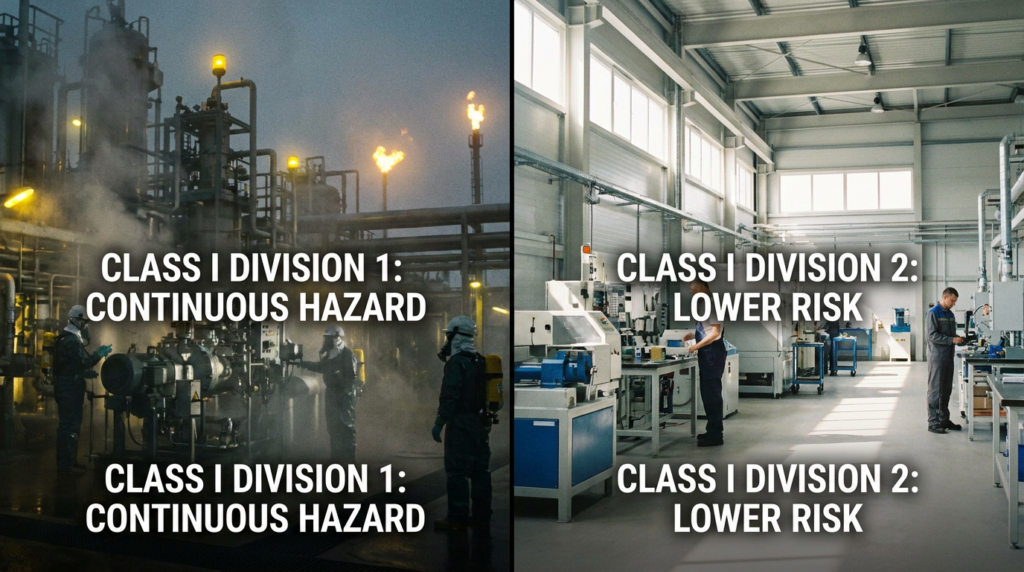
Navigating the Decision: Choosing Between Class I, Division 1 and Division 2 Instrumentation
Making the correct choice between Class I, Division 1 and Class I, Division 2 instrumentation is far more than a simple line item on a procurement order; it is a critical decision that sits at the nexus of operational safety, financial investment, and regulatory compliance. This selection process is not for the faint of heart, nor is it a task to be delegated without careful consideration. It demands a deep, nuanced understanding of the specific environment where the equipment will live and breathe. The individuals and teams tasked with this decision are essentially drawing a line in the sand, defining the boundary between acceptable risk and potential catastrophe. This responsibility typically falls to a collaborative group of professionals, each bringing a unique and vital perspective to the table. Process engineers, safety managers, instrumentation and control (I&C) engineers, and plant operations leaders must work in concert, armed with detailed knowledge of their facility’s specific hazards. A miscalculation here doesn’t just lead to a failed audit; it can create the perfect, tragic storm of conditions for an explosion, jeopardizing lives, the environment, and the very existence of the facility.
- Process engineers
- Safety managers
- Instrumentation and control (I&C) engineers
- Plant operations leaders
Essential Safety Architecture: Core Components for Hazardous Environments
| Equipment Type | Core Application | Access |
|---|---|---|
| Digital Pressure Calibrator | High-precision field testing, pressure maintenance, and safety verification within zone-rated hazardous areas. | Explore Solutions |
| Hazardous Area Flow Computer | Real-time fluid measurement, custody transfer data logging, and advanced process automation loops. | Explore Solutions |
| Intrinsically Safe Isolator Barrier | Safe-area to hazardous-area galvanic isolation, protecting sensitive instrumentation from dangerous energy surges. | Explore Solutions |
Equip Your Facility with Certified Instrumentation
Browse our extensive catalog of explosion-proof and intrinsically safe transmitters, flow meters, and barriers engineered for high-risk industrial environments.
Shop Division 1 & 2 InstrumentsFAQs
What is the fundamental difference between a Class I, Division 1 and a Class I, Division 2 location?
The fundamental difference is the likelihood of the hazardous atmosphere being present. In a Division 1 location, the hazardous atmosphere is expected to be present under normal operating conditions. In a Division 2 location, the hazardous atmosphere is only expected to be present under abnormal conditions, such as a leak or equipment failure.
Can I use a Division 1 rated instrument in a Division 2 area?
Yes, you can always use a more robust Division 1 rated instrument in a Division 2 area. However, you can never use a Division 2 instrument in a Division 1 area.
How does the choice between Div 1 and Div 2 impact project cost and maintenance?
Division 1 equipment is significantly more expensive to purchase and install. Maintenance is also more complex and may require a shutdown. Division 2 equipment is less expensive, easier to install, and can often be maintained while the circuit is live, reducing downtime.
What are the most common protection methods for Division 1?
The most common protection methods for Division 1 are explosion-proof enclosures and intrinsic safety (IS).
What is a non-incendive instrument?
A non-incendive instrument is a type of Division 2 equipment that is designed so that its electrical circuits will not cause ignition in a hazardous atmosphere during normal operation.
Conclusion
The journey through the landscape of Class I, Division 1 and Division 2 instrumentation reveals that the selection process is not merely a technical task but a strategic imperative. The final decision is a synthesis of rigorous engineering analysis, astute financial planning, and a profound commitment to an organization’s safety culture. It moves far beyond the simple question of “what does the code require?” and into the more nuanced territory of “what is the most responsible and intelligent way to manage our specific risk?” The core distinction, rooted in whether a hazardous atmosphere is a normal operational condition or an abnormal accident, serves as the primary fork in the road, directing every subsequent choice about equipment, installation methodology, and long-term maintenance. Understanding this fundamental difference is the key that unlocks the ability to build a system that is not only compliant but is also optimized for safety, reliability, and total cost of ownership.
