























When working in a Hazardous environment, you may have come across an enclosure or two without even noticing it. However, what is Class 1 or Division 2? Or better yet, what is a Class 1 Division 2 enclosure?
Master Hazardous Area Classifications
Equip your team with the knowledge to maintain strict compliance and facility safety. Access our comprehensive breakdown of hazardous locations, complete with real-world industrial applications.
Access the Beginner’s GuideClass I Division 2 Fundamentals
Let’s define Class 1 Division 2.
Class 1 defines locations where flammable gases or vapors may be present in the air. Additionally, sufficient quantities of flammable substances may produce explosive or ignitable mixtures. There are two Divisions and three Zones that subdivide Class I.
Class I, Division 1: Three different situations could exist to classify an area as a Class I, Division 1 location.
- Ignitable concentrations of flammable gases or vapors may exist under normal operating conditions.
- Ignitable concentrations of gases or vapors may frequently circulate the location because of repair, maintenance operations, or leakage.
- Faulty operation of equipment and processes might release ignitable concentrations of hazardous substances. Also, the concentration of gases and vapors may potentially cause simultaneous failure of electric equipment.
Class I, Division 2: Three situations exist for an area to consider a location as Class I, Division 2.
- Facilities handling, processing, or using volatile flammable liquids or flammable gases. However, the hazardous liquids or gases confine within closed containers or closed systems. Only in the event of accidental rupture, breakdown, or abnormal operation of containers or systems will the hazardous substance escape.
- Mechanical ventilation prevents ignitable concentrations of gases or vapors from becoming hazardous.
- Similar to Class I, Division 1 location, ignitable concentrations of gases or vapors might occasionally circulate. Yet, by utilizing positive-pressure ventilation from a source of clean air and safeguards against ventilation failure, the circulation of hazardous substances can be prevented.
To summarize
Class 1 Hazardous Locations refer to facilities that deal with flammable gases, vapors, and liquids.
Division 2 specifies that flammable materials are handled, processed, or used at a location. But, concentrations of hazardous substances are not high enough to be ignitable.
This applies to devices such as Flashlights, Meter readers, Enclosures, etc.
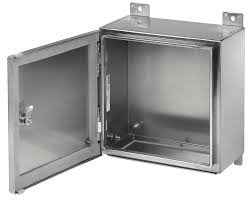
So a Class 1 Division 2 Enclosure is used in facilities that deal with flammable gases, vapors, and liquid materials. Additionally, the facility handling, processing, or using the materials in the defined hazardous location contain concentrations insufficient to be ignitable.
Enclosure Types & Materials
The material and design of a Class 1 Division 2 enclosure are critical to its performance and longevity. The choice depends on the specific environmental conditions, the nature of the hazardous substances present, and the required level of protection. Key considerations include corrosion resistance, impact strength, and weight.
Metallic vs Non-Metallic
Enclosures are broadly categorized into metallic and non-metallic types, each with distinct advantages.
- Metallic Enclosures: Commonly made from materials like stainless steel or cast aluminum, these offer superior strength and impact resistance. Stainless steel provides excellent corrosion resistance, making it ideal for offshore or chemical processing plants. Aluminum is lighter and offers good durability, often used where weight is a consideration.
- Non-Metallic Enclosures: Materials such as polycarbonate and fiberglass are popular non-metallic options. They provide excellent resistance to chemical corrosion and are significantly lighter than their metallic counterparts. Fiberglass enclosures are extremely durable, while polycarbonate offers high impact resistance and is easier to modify on-site. The choice between them often comes down to the specific chemical exposures and physical stresses expected.
Secure Your Equipment with Certified C1D2 Enclosures
Whether your application requires the rugged durability of stainless steel or the lightweight, chemical resistance of fiberglass, we supply a vast inventory of enclosures engineered specifically for Class 1 Division 2 environments.
Shop Explosion-Proof EnclosuresCertification Standards (NEC, ATEX, IECEx)
Compliance with international safety standards is non-negotiable for equipment used in hazardous areas. For Class 1 Division 2 enclosures, three primary certification bodies set the standards globally: NEC, ATEX, and IECEx. Understanding these is key for ensuring global compliance.
- NEC (National Electrical Code): This is the standard used primarily in the United States. It defines hazardous locations using the Class, Division, and Group system. A Class 1 Division 2 enclosure is certified to be safe where flammable gases or vapors are present only under abnormal conditions.
- ATEX (Atmosphères Explosibles): This is the European Union’s directive for equipment used in potentially explosive atmospheres. The ATEX system uses Zones. A location classified as Class I, Division 2 under NEC standards is roughly equivalent to Zone 2 under ATEX. An ATEX-certified enclosure for Zone 2 ensures it is protected against arcs, sparks, or high temperatures during normal operation.
- IECEx (International Electrotechnical Commission System): This is an international certification system accepted in many countries worldwide. It aims to harmonize standards, making global trade of hazardous area equipment simpler. An IECEx certificate demonstrates that an enclosure has been independently tested and meets international safety requirements, often aligning closely with ATEX standards. An enclosure with both ATEX and IECEx certification offers the widest range of international acceptance.
Installation & Maintenance Best Practices
Proper installation and regular maintenance are crucial for ensuring a Class 1 Division 2 enclosure maintains its safety rating throughout its service life. Failure to follow best practices can compromise the integrity of the protection and create a safety hazard.
- Correct Installation: Always use the correct cable glands, conduit seals, and stopping plugs that are rated for the hazardous area. Ensure all entries are properly sealed to prevent the ingress of flammable gases or vapors. All installation work should be performed by personnel trained in hazardous area wiring.
- Regular Inspections: Periodically inspect enclosures for signs of physical damage, corrosion, or gasket deterioration. Gaskets must be in perfect condition to maintain the seal (e.g., NEMA Type 4X rating). Any compromised component should be replaced immediately with manufacturer-approved parts.
- Avoid Unauthorized Modifications: Do not drill new holes or make other modifications to a certified enclosure in the field unless you are following specific manufacturer guidelines and have the authority to do so. Unauthorized changes will void the certification.
- Documentation: Keep a maintenance log for each enclosure, detailing inspection dates, findings, and any repairs performed. This helps ensure accountability and a consistent maintenance schedule.
Frequently Asked Questions (FAQs) About Class 1 Division 2
What is the main difference between Class 1 Division 1 and Division 2?
The primary difference lies in the likelihood of hazardous materials being present. In a Division 1 location, ignitable concentrations of flammable gases or vapors are present during normal, day-to-day operations. In a Division 2 location, these volatile substances are contained within closed systems and are only present in the atmosphere under abnormal conditions, such as an accidental leak or equipment failure.
Does a Class 1 Division 2 area require explosion-proof enclosures?
Not necessarily. While Division 1 requires heavy-duty, explosion-proof enclosures engineered to contain an internal explosion, Division 2 enclosures primarily focus on preventing the enclosure from becoming an ignition source in the first place. Non-incendive equipment and appropriately sealed C1D2 enclosures are generally acceptable and more cost-effective for Division 2 areas.
Can a standard industrial enclosure be used in a Division 2 location?
No. A standard industrial enclosure does not meet the stringent safety standards required for hazardous areas. Enclosures used in these environments must be specifically rated, tested, and certified for Class 1 Division 2 use under NEC, ATEX, or IECEx standards to guarantee they will not produce arcs, sparks, or dangerous temperatures.
What industries commonly use Class 1 Division 2 enclosures?
Class 1 Division 2 enclosures are essential for any industry that processes, stores, or handles volatile liquids and gases. Common applications include oil and gas refineries, chemical blending plants, pharmaceutical manufacturing, wastewater treatment facilities, and renewable energy plants like hydrogen or biofuel processing.
Is a Class 1 Division 2 rating the same as ATEX Zone 2?
They are roughly equivalent but operate under different international regulatory bodies. Class 1 Division 2 is the standard defined by the National Electrical Code (NEC) used primarily in North America. ATEX Zone 2 is the European Union’s corresponding directive for equipment used in potentially explosive atmospheres. Many top-tier enclosures carry both certifications for global compliance.