






















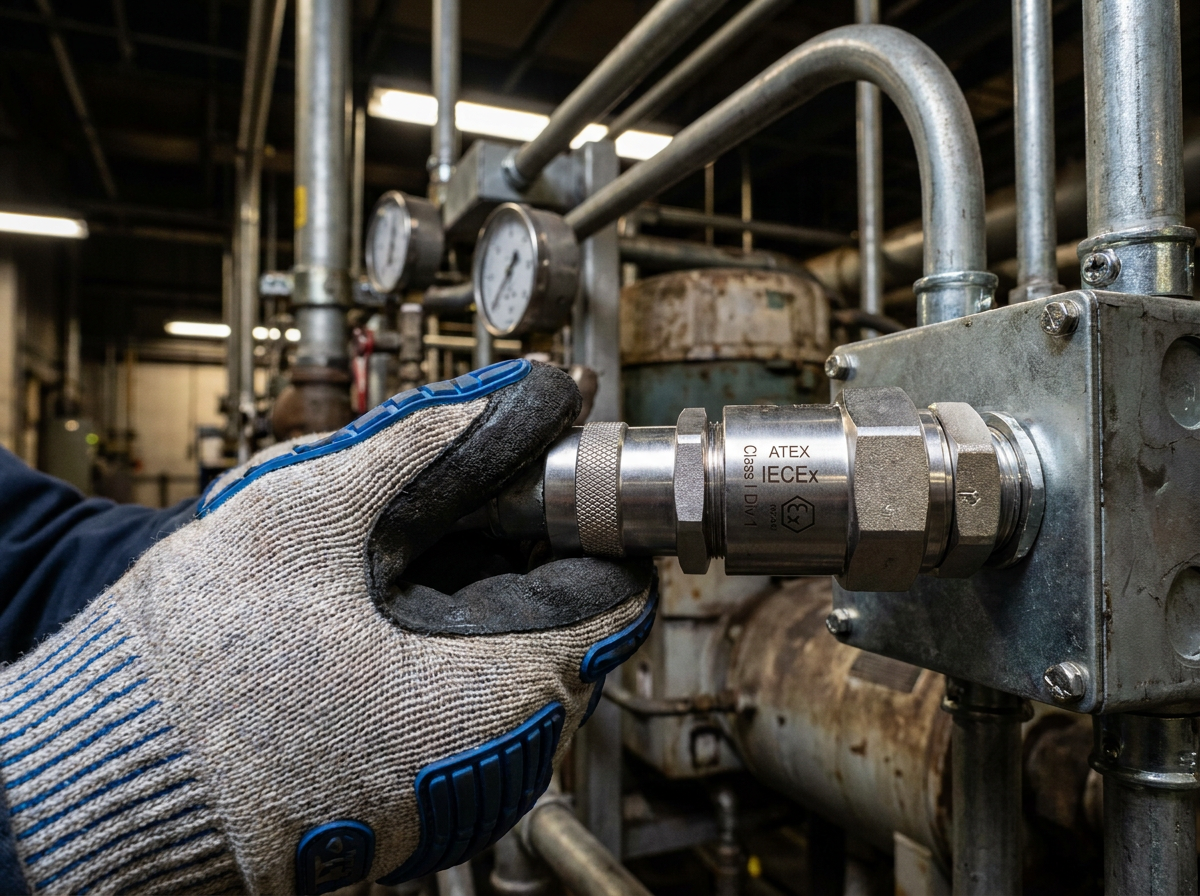
In the high-stakes world of industrial operations, where efficiency and safety are locked in a constant, critical dance, the flow of data is everything. From the sprawling infrastructure of an offshore oil rig to the sterile precision of a pharmaceutical manufacturing line, digital networks act as the central nervous system, transmitting vital commands and feedback that govern production, monitor processes, and protect personnel. But what happens when this nervous system must extend into environments where the very air is a potential fuel for disaster? In these hazardous areas, defined by the presence of flammable gases, combustible dusts, or volatile vapors, the rules of engineering are rewritten. Here, a single component, as seemingly insignificant as a network connector, transforms from a simple piece of hardware into a critical safety device. The selection of this component is not a trivial task of matching a plug to a socket; it is a complex, multi-layered discipline that sits at the intersection of electrical engineering, chemical safety, and international law. This guide is designed to demystify that process, providing you with the deep insights and practical knowledge needed to navigate the intricate landscape of certified connectors, ensuring your network is not only a conduit for data but a bastion of safety.
Demystify Hazardous Area Compliance
Navigate ATEX, IECEx, and IP ratings with confidence. Access our comprehensive guide on essential components and materials for volatile environments to ensure your next installation meets all global safety directives.
Read the Components GuideNavigating the Critical Choice: Understanding Certified Connectors for Hazardous Area Networks
In the modern industrial landscape, data is the lifeblood of efficiency, safety, and productivity. From the sprawling infrastructure of an oil refinery to the intricate processes within a pharmaceutical plant, networks are the veins and arteries carrying this vital information. However, when these networks must extend into environments classified as hazardous—areas where flammable gases, combustible dust, or volatile vapors are present—the rules of engagement change dramatically. In these settings, a single, minuscule spark from a piece of electrical equipment can have catastrophic consequences. This is where the discipline of hazardous area engineering becomes paramount, and at its very core lies the critical task of selecting certified connectors. This selection process is far more than a simple matter of matching a plug to a socket; it is a complex, multi-layered decision-making exercise that balances operational requirements with the non-negotiable mandate of safety. It involves a deep understanding of physics, chemistry, and regulatory compliance, ensuring that the digital nervous system of a facility does not become its most significant liability.
Key Benefits of Certified Connectors
- Enhanced Safety: Certified connectors are rigorously tested to prevent ignition in hazardous atmospheres, ensuring the safety of personnel and facilities.
- Improved Operational Efficiency: Hot-swappable certified connectors allow for live maintenance without shutting down systems, drastically reducing downtime.
- Lower Total Cost of Ownership: While the initial cost may be higher, certified connectors reduce long-term costs through increased durability, reduced maintenance, and prevention of catastrophic failures.
- Simplified Compliance: Using certified connectors provides a clear, auditable trail of compliance with safety standards like ATEX and IECEx.
- Increased Flexibility: The modular nature of certified connectors simplifies system design, installation, and future scalability.

Secure Your Critical Network Infrastructure
Mitigate ignition risks without sacrificing data speed. Explore our rigorous lineup of explosion-proof cable connectors built for the industry’s most demanding environments.
Shop Explosion-Proof ConnectorsHazardous Area Connector Specifications
| PROTECTION TYPE | SAFETY APPROACH | HOT SWAPPING | MINIMUM IP RATING | PRIMARY APPLICATION |
|---|---|---|---|---|
| Explosion-Proof (Ex d) | Contains internal explosions and prevents flame propagation to the surrounding atmosphere. Heavy-duty enclosure. | Strictly Prohibited | IP54 | High-power networks, heavy machinery, backbone switches. |
| Intrinsically Safe (Ex i) | Limits electrical and thermal energy levels below the threshold required to ignite volatile gases or dust. | Fully Supported | IP20 | Instrumentation, live network maintenance, low-power sensors. |
| Dust Ignition Protection (Ex t) | Utilizes tight, dust-proof seals to completely prevent combustible dust ingress into internal components. | Prohibited during active dust presence | IP6X (Dust-Tight) | Grain silos, pharmaceutical powder processing, milling facilities. |
FAQs
What exactly defines a “hazardous area” and why do I need special connectors for my network?
A hazardous area is any space where the atmosphere contains, or has the potential to contain, a sufficient concentration of flammable or explosive substances to cause a fire or explosion. You need special certified connectors because standard connectors can create sparks or heat up, which can act as an ignition source in these volatile environments. Certified connectors are engineered and tested to prevent this, ensuring the safety of your facility.
What is the real-world difference between an Explosion-Proof (Ex d) and an Intrinsically Safe (Ex i) connector?
An Explosion-Proof (Ex d) connector is designed to contain an internal explosion and prevent it from igniting the surrounding atmosphere. It’s a robust, heavy-duty solution. An Intrinsically Safe (Ex i) connector, on the other hand, is part of a system that limits the electrical and thermal energy to a level so low that it cannot cause ignition in the first place. The choice between them depends on the power requirements of the application and the overall safety philosophy.
How do I interpret the complex certification markings on a connector, like ATEX or IECEx codes?
Certification markings are a summary of a connector’s capabilities. They tell you the protection method used (e.g., ‘d’ for flameproof, ‘i’ for intrinsic safety), the gas or dust group it’s safe for, the maximum surface temperature (T-rating), and the Equipment Protection Level (EPL), which links it to a specific hazardous zone. Understanding these codes is essential for ensuring the connector is appropriate for your specific environment.
Can I use a connector that is certified for a gas environment in an area with combustible dust?
No, not unless the connector is explicitly dual-certified for both gas and dust. The physics of ignition for gas and dust are different, and so are the testing standards. A connector certified for gas may not prevent dust ingress or may get too hot when covered in a layer of dust, creating a new hazard. Always check for the specific ‘D’ designator for dust certification.
Why is the IP rating important for a hazardous area connector?
The Ingress Protection (IP) rating is critical because it defines the connector’s ability to resist the intrusion of dust and water. A hazardous area can also be wet or dusty, and a connector with a poor IP rating can allow contaminants to enter, leading to corrosion, short circuits, and a failure of the safety system. A high IP rating (like IP67 or IP68) is often essential for ensuring long-term reliability and safety.
Conclusion
The journey through the world of certified connectors for hazardous area networks reveals a fundamental truth: in these critical environments, there are no small decisions. The selection of a connector is a profound responsibility, a choice that reverberates through the safety, efficiency, and compliance of an entire facility. By treating every connection point as the critical safety device it is, you are not just adhering to regulations; you are making a powerful commitment to the well-being of your people, the protection of your assets, and the long-term integrity of your operations. In the final analysis, the strongest network is not the one that transmits data the fastest, but the one built on an unshakeable foundation of safety, where every connection is a testament to expertise, responsibility, and an unwavering commitment to getting it right.
