

Intrinsically Safe Products
Mastering Accuracy: The Definitive Guide to Catalytic Gas Sensor Calibration
In the high-stakes world of industrial safety, some of the greatest threats are the ones we cannot see. Invisible, odorless, and highly combustible gases like methane, propane, and hydrogen can accumulate silently in the atmosphere of a refinery, a chemical plant, or a confined workspace, waiting for a single spark to trigger a catastrophic event. Standing guard against this unseen danger is the catalytic gas sensor, a small but powerful device engineered to be the first line of defense. Yet, this guardian’s vigilance is not inherent; it is earned. A sensor straight out of the box is merely a piece of sophisticated electronics with potential. It is the meticulous, disciplined act of calibration that transforms that potential into reliable, life-saving performance. This process is the critical link that instills confidence in every reading, ensuring that a “zero” on the display truly means the air is safe and that an alarm is an undeniable call to action. This guide is designed to be your comprehensive resource, moving beyond simple instructions to explore the fundamental principles, the profound benefits, the practical step-by-step procedures, and the critical timing that define a world-class gas sensor calibration program. We will delve into who is qualified to perform this vital task, where to find authoritative procedures, and answer the most pressing questions to empower you to manage this cornerstone of industrial safety with the expertise and diligence it demands.
2026 Gas Detector Buying Guide
Selecting the right equipment is critical for site safety and regulatory compliance. Read our updated 2026 guide to identify the best intrinsically safe solutions for your facility.
Read the 2026 Buying GuideUnderstanding the Core Principles: A Deep Dive into Catalytic Gas Sensor Calibration Procedures
Calibration, in the context of catalytic gas sensors, is far more than a simple maintenance task; it is the foundational process that transforms a piece of electronic equipment into a reliable, life-saving instrument. These sensors are the silent sentinels in countless industrial environments, from offshore oil rigs and chemical processing plants to wastewater treatment facilities and underground mines, standing guard against the invisible threat of combustible gases. Their entire purpose is to detect the build-up of flammable gases and vapours before they reach a concentration in the air that could be ignited, leading to a catastrophic fire or explosion. However, a sensor is only as good as its last calibration. Without this meticulous procedure, the device’s readings are, at best, questionable and, at worst, dangerously misleading. The process of calibration is what instills confidence and certainty, ensuring that when the device reads “0% LEL,” the air is truly safe, and when it alarms, the threat is genuinely present. It is the critical link between the sensor’s technology and the trust we place in it to protect lives and assets.
At its heart, the calibration procedure for a catalytic gas sensor is a process of comparison and adjustment. It involves exposing the sensor to a known and certified standard to verify its response and, if necessary, adjust its internal programming to match that standard. Think of it like tuning a guitar; you play a note and compare it to a reference pitch from a tuning fork or an electronic tuner. If the note is flat or sharp, you adjust the string’s tension until it perfectly matches the reference. Similarly, a catalytic sensor is “tuned” against a known concentration of gas. This process is fundamentally divided into two critical stages: the zero calibration and the span calibration. The zero calibration establishes the baseline, or the “zero point,” for the sensor. This is performed in an environment known to be free of any target combustible gases, typically using fresh, clean air or a cylinder of certified zero-grade air. This step is crucial because it tells the sensor what a “safe” atmosphere looks like, effectively resetting its starting point. Over time, environmental factors, humidity, and subtle aging of the sensor components can cause a phenomenon known as “zero drift,” where the sensor might show a small reading even in clean air. Performing a zero calibration corrects this drift, preventing potential false alarms and ensuring that any subsequent reading is a true representation of a gas presence, not an artifact of a drifting baseline.
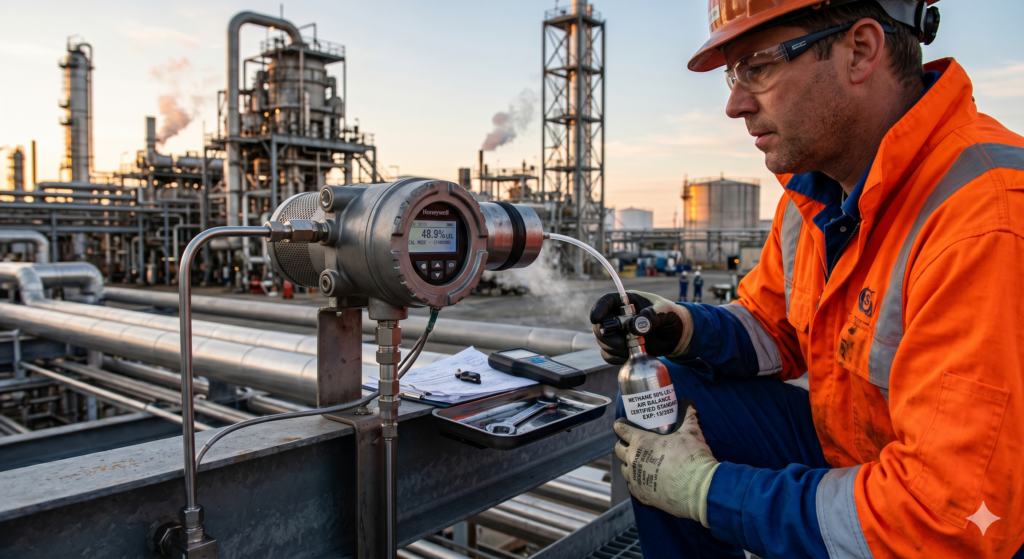
Following a successful zero calibration, the next and arguably more defining step is the span calibration. This is where the sensor’s accuracy across its measurement range is verified and set. The procedure involves introducing a specific, known concentration of a calibration gas to the sensor. This gas is not just any flammable gas; it is a precisely blended mixture, certified by the supplier, typically containing a target gas like methane, propane, or pentane balanced in air. The concentration is usually a specific percentage of the Lower Explosive Limit (LEL) of that gas, often 50% LEL. The LEL is the minimum concentration of a particular combustible gas in the air that will propagate a flame if an ignition source is present. By exposing the sensor to a gas at 50% LEL, for example, the technician is checking if the sensor accurately reads “50% LEL” on its display. If the reading is different, the instrument’s internal software is adjusted until its output precisely matches the value of the gas being applied. This adjustment is what truly calibrates the sensor. It is important to understand the underlying technology here. A catalytic sensor works by using two tiny ceramic beads, or pellistors. One is an active bead coated with a catalyst, and the other is an inert reference bead. When a combustible gas comes into contact with the active bead, it oxidizes (burns), raising the bead’s temperature. This temperature change alters its electrical resistance, which is measured in a Wheatstone bridge circuit against the stable reference bead. The change in resistance is directly proportional to the gas concentration. The span calibration process is essentially teaching the sensor’s microprocessor exactly what change in resistance corresponds to a specific, real-world gas concentration, ensuring its response is both linear and accurate.
It is critically important to distinguish between a full calibration and a “bump test,” as the two are often confused, yet serve very different purposes. A bump test is a qualitative functional check, not a quantitative measurement adjustment. Its purpose is simply to verify that the sensor is responding to gas and that the device’s alarms—audible, visual, and vibratory—are working correctly. During a bump test, a small amount of gas is briefly applied to the sensor, just enough to push it into alarm. The user is not concerned with the accuracy of the. It is a quick, go/no-go test performed before each day’s use to ensure the instrument has not suffered a catastrophic failure. Calibration, on the other hand, is a much more involved, quantitative procedure that adjusts the sensor’s response to ensure its accuracy. While a bump test confirms the sensor is alive, a calibration confirms it is telling the truth. Relying solely on bump tests without a regular calibration schedule is a dangerous practice, as it allows the sensor’s accuracy to slowly degrade over time, a condition known as “calibration drift,” without being corrected. A sensor that passes a bump test could still be reading 20% low, meaning it would only alarm at a true concentration of 60% LEL when it should have alarmed at 50% LEL, a delay that could be the difference between a safe evacuation and a disaster.
Portable Intrinsically Safe Gas Detectors
Ensure reliable performance in hazardous environments. Explore our range of certified portable gas detectors engineered for maximum precision and industrial durability.
Browse Portable DetectorsThe Guardians of Gas Detection: Identifying the Right Personnel for Catalytic Sensor Calibration
Entrusting the calibration of catalytic gas sensors is not a decision to be taken lightly. This procedure is far more than a simple administrative task or a box to be ticked on a maintenance checklist; it is a fundamental pillar of industrial safety, a critical process that stands between a normal workday and a catastrophic event. The accuracy of these sensors, which are designed to detect combustible gases like methane, propane, and hydrogen, is the frontline defense against fires and explosions in countless environments, from oil rigs and chemical plants to wastewater treatment facilities and manufacturing sites. When a sensor provides a false negative or an inaccurate reading, the consequences can be devastating. Therefore, the question of who should perform these calibrations is paramount. The answer is not a single job title but rather a profile of an individual or team defined by a rigorous combination of training, technical expertise, meticulous attention to detail, and an unwavering commitment to safety protocols.
- The absolute, non-negotiable foundation for anyone performing this task is formal, comprehensive training and, ideally, certification.
- In most industrial settings, the hands-on responsibility for calibration falls to a dedicated Instrument Technician, an Electrical & Instrumentation (E&I) Technician, or a similarly skilled professional.
- While technicians are the tactical executors, strategic oversight is often provided by a Safety Officer, Industrial Hygienist, or a Process Safety Engineer.
- A significant strategic decision for any facility is whether to build an in-house team of experts or to outsource calibration to a specialised third-party service provider.
Core Pillars of Catalytic Sensor Calibration
| Calibration Stage | Procedure & Methodology | Safety Objective |
|---|---|---|
| Zero Calibration | Performed in a clean-air environment or using zero-grade air to establish the baseline. Corrects “zero drift” caused by environmental factors. | Ensures “0% LEL” accurately represents an atmosphere free of combustible gases. |
| Span Calibration | Introduction of a certified gas concentration (e.g., 50% LEL Methane). Adjusts the microprocessor to match the known physical standard. | Guarantees quantitative accuracy and linearity across the entire detection range. |
| Bump Testing | A qualitative “go/no-go” functional check. Brief exposure to gas to verify that sensors respond and all alarms activate correctly. | Daily verification that the unit is operational before entering hazardous areas. |
| Qualified Personnel | Execution by E&I Technicians or Safety Engineers with formal certification and deep understanding of manufacturer manuals. | Prevents human error and ensures the legal defensibility of the safety program. |
| Environmental Auditing | Monitoring for “sensor poisons” like silicones or lead compounds that can desensitize the catalytic beads. | Proactive protection of hardware to prevent premature sensor failure. |
The Unseen Guardian: Core Benefits of Rigorous Catalytic Gas Sensor Calibration
Viewing the calibration of a catalytic gas sensor as a mere procedural checkbox is to fundamentally misunderstand its role. It is not simply a maintenance task to be ticked off a list; it is the very process that breathes reliability, accuracy, and trustworthiness into a device tasked with the critical duty of protecting lives, assets, and the environment. The benefits of a robust and consistent calibration regimen extend far beyond a simple pass/fail result on a technician’s report. They permeate every layer of an operation, from the confidence of the worker on the plant floor to the strategic decisions made in the boardroom. This procedure is the foundational pillar upon which the entire safety integrity of a gas detection system is built, transforming a piece of sophisticated electronics into a dependable guardian against unseen and often catastrophic hazards. Without it, a gas sensor is little more than a guess, an expensive and ultimately useless ornament in a high-stakes environment.
- The most immediate and fundamental benefit of proper calibration is the assurance of accuracy.
- Flowing directly from this principle of accuracy is the paramount benefit of enhanced workplace safety.
- Beyond the immediate safety implications, consistent calibration is a cornerstone of regulatory compliance and legal defensibility.
- This proactive approach also yields significant financial benefits, often in ways that are not immediately obvious.

A Practical Guide to Initiating Catalytic Gas Sensor Calibration
Embarking on the calibration of a catalytic gas sensor is a journey into the very heart of gas detection safety and accuracy. It is far more than a simple button-pushing exercise; it is a meticulous process that demands preparation, understanding, and a deep respect for the equipment and the volatile environments it is designed to monitor. Before you even think about connecting a gas cylinder, your first step should be to assemble your complete calibration toolkit and, more importantly, the knowledge required to use it effectively. This means gathering your specific calibration gas cylinder, a compatible regulator, the correct tubing, and the sensor’s calibration adapter. The single most important item in this initial phase, however, is the manufacturer’s instruction manual. This document is your definitive guide, containing the precise parameters, gas concentrations, flow rates, and procedural steps tailored to your specific instrument. Ignoring it is akin to navigating without a map; you might get somewhere, but it is unlikely to be the correct destination. Pay close attention to your calibration gas. It must be a certified mixture of a known concentration, such as 50% of the Lower Explosive Limit (LEL) of methane, and it must be within its expiration date. Using expired gas is a cardinal sin in calibration, as the gas concentration can degrade over time, leading to a dangerously inaccurate calibration where the sensor is less sensitive than you believe it to be. Similarly, the regulator is not just a valve; it is a precision instrument designed to deliver the gas at a specific, constant flow rate, often around 0.5 to 1.0 liter per minute. Using an incorrect or faulty regulator can either flood the sensor or starve it of gas, both of which will invalidate the entire procedure.
FAQs
What is the real difference between a bump test and a full calibration?
A bump test is a qualitative functional check to verify sensor response and alarm function, while a full calibration is a quantitative procedure to adjust the sensor’s accuracy.
How often should I really be calibrating my catalytic sensors?
The frequency depends on manufacturer recommendations, regulatory standards, and the harshness of the application environment. A risk-based approach is best.
Why is zeroing the sensor so important before applying span gas?
Zeroing establishes the baseline for all measurements. An incorrect zero will skew all subsequent readings, leading to inaccurate and potentially unsafe performance.
What are the most common reasons for a calibration to fail?
Common causes include expired calibration gas, incorrect flow rates, faulty equipment, sensor aging, or exposure to poisons like silicones or lead compounds.
Conclusion
As we have explored, the calibration of a catalytic gas sensor is a subject of immense depth, extending far beyond a simple technical checklist. It is a fundamental pillar of any credible safety program, a non-negotiable process that underpins the very reliability of your first line of defense against combustible gas hazards. We have journeyed from the core scientific principles of catalytic oxidation to the practical, hands-on steps of applying span gas, and it is clear that true mastery lies in understanding the complete picture. It is about recognizing that a bump test confirms function while a calibration guarantees accuracy, and that both are essential but not interchangeable. It is about appreciating that the timing of a calibration is not just about a date on a calendar but is also dictated by events—a high gas exposure, a potential poisoning, or the critical moments before a confined space entry. The true measure of a safe operation is not just owning gas detectors, but ensuring, through rigorous and documented calibration, that they are unwavering sources of truth in moments of uncertainty.
