
























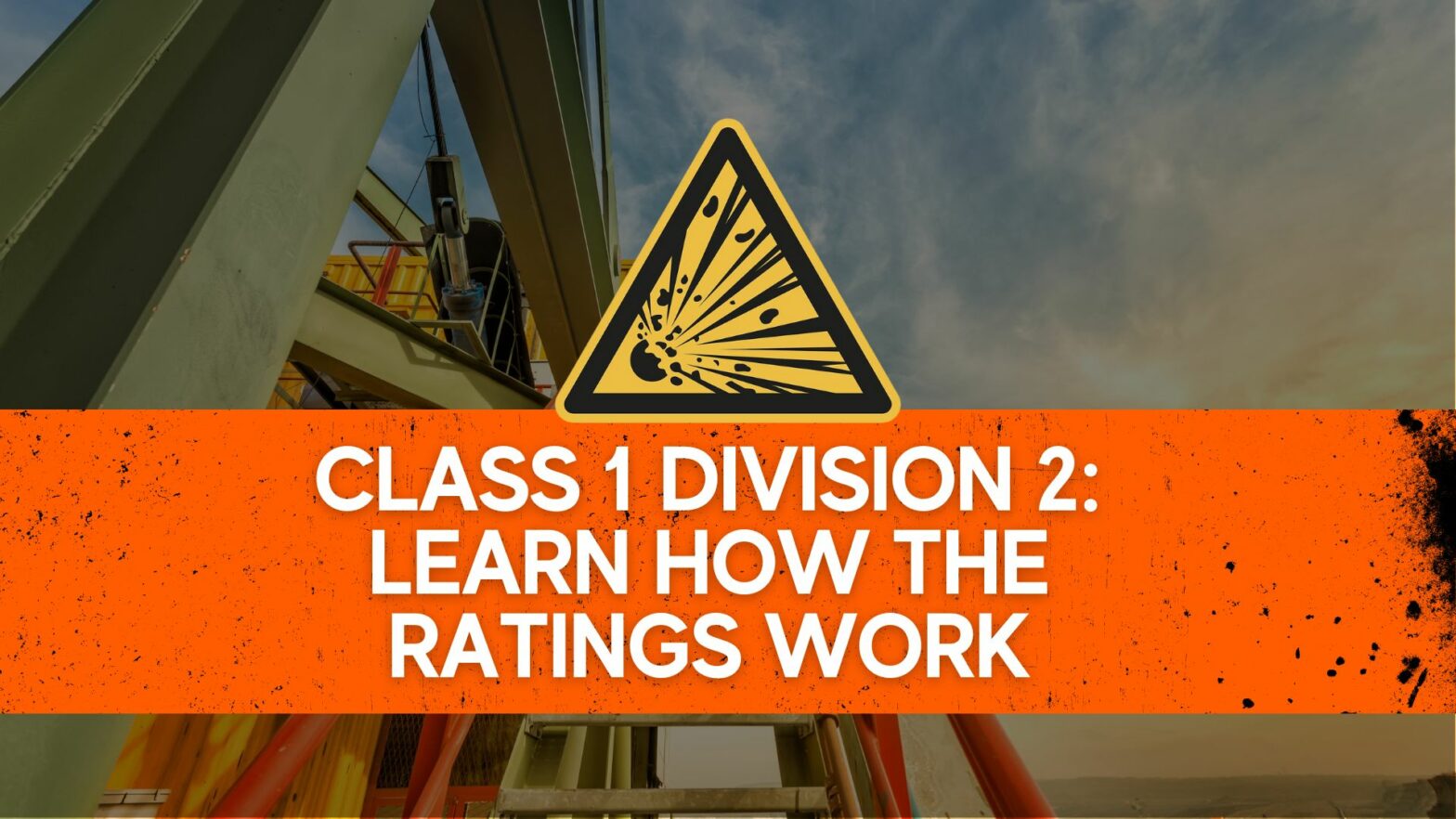
There are some safety standards that you might recognize, like Class 1 Div 2, but do you really know what it means? Protecting the public, workforce, and environment from explosive atmospheres is a top priority but not a universal standard. Therefore, in the United States, NEC (National Electric Code) classifies HAZLOC (Hazardous Locations) by classes and divisions for the type of material present in each zone. In contrast, IEC (International Electrotechnical Commission) classifies HAZLOC by zones. In this post, you will understand more about these safety ratings.
What Does Class 1 Division 2 Mean? (The Simple Definition)
In simple terms, Class 1 Division 2 (C1D2) defines a hazardous location where flammable gases, vapors, or liquids (Class 1) are not present during normal operating conditions. However, these hazardous substances could be present temporarily due to accidental ruptures, leaks, or equipment breakdowns (Division 2).
This rating is a critical safety standard for any facility that handles volatile materials. It signals that while the area is generally safe, electrical equipment must be specifically designed to prevent ignition in the event of a fault or accident.
Breaking Down the Code: Class, Division, and Group Explained
To fully grasp C1D2, it’s essential to understand the National Electrical Code (NEC) system, which categorizes hazardous locations. This system is used by organizations like the National Fire Protection Association (NFPA) and Underwriters Laboratories (UL) to ensure safe electrical installations. The classification is broken down into three parts: Class, Division, and Group.
Class: The Type of Hazardous Material
The Class defines the physical nature of the flammable substance present in the atmosphere.
- Class I: Flammable gases or vapors are present in the air in quantities sufficient to produce explosive or ignitable mixtures. This is the category relevant for Class 1 Div 2.
- Class II: Combustible dust is present.
- Class III: Easily ignitable fibers or flyings are present, but not likely to be in suspension in the air in quantities sufficient to produce ignitable mixtures.
Division: The Likelihood of Hazard Presence
The Division describes the probability of the hazardous material being present in a combustible concentration.
- Division 1: Ignitable concentrations of hazards exist under normal operating conditions, during frequent maintenance, or due to equipment malfunction.
- Division 2: Ignitable concentrations of hazards are present only under abnormal operating conditions, such as an accidental container rupture or system breakdown.
Group: The Specific Substance
The Group classifies the hazardous material by its specific properties, such as its ignition temperature and explosion pressure. This is crucial for selecting appropriate equipment.
- Group A: Acetylene
- Group B: Hydrogen, butadiene, ethylene oxide, propylene oxide, and acrolein
- Group C: Ethylene, cyclopropane, and ethyl ether
- Group D: Acetone, ammonia, benzene, butane, ethanol, gasoline, hexane, methane, methanol, natural gas, propane, and toluene
- Group E: Combustible metal dust (e.g., aluminum, magnesium)
- Group F: Combustible carbonaceous dust (e.g., carbon black, charcoal, coal)
- Group G: Other combustible dusts (e.g., flour, grain, plastic, wood)
Class 1 Div 2 vs. Class 1 Div 1: The Key Difference
The primary distinction between Class 1 Division 1 and Class 1 Division 2 is the likelihood of an explosive atmosphere being present.
- Class 1 Division 1: The hazard is expected to be present continuously or intermittently during normal operations. This requires the highest level of protection, often mandating intrinsically safe or explosion-proof equipment.
- Class 1 Division 2: The hazard is present only during abnormal conditions. The equipment for this area is designed to be non-sparking during normal operation, on the assumption that an equipment fault and a hazardous substance leak are unlikely to occur simultaneously.
Think of it this way: A C1D1 area is like the inside of a paint mixing tank where flammable vapors are always present. A C1D2 area is the room outside the tank, where vapors would only accumulate if the tank developed a leak.
Real-World Examples of Class 1 Division 2 Environments
Understanding where these classifications apply is key to ensuring safety. Common C1D2 locations include:
- Petroleum Refineries: Areas adjacent to processing units, pumps, and pipelines where leaks could occur.
- Chemical Processing Plants: Storage facilities or areas near sealed valves and fittings that could fail.
- Fuel Storage Facilities: Areas surrounding storage tanks and dispensing units.
- Utility Gas Plants: Locations where natural gas is processed and transported but is contained within a closed system during normal operation.
- Aircraft Hangars: Areas where fuel spills are possible but not a constant presence.
What Equipment is Certified for Class 1 Division 2?
To operate safely in a C1D2 location, electrical and electronic equipment must be certified to not be an ignition source. This doesn’t always mean it has to be fully “explosion-proof.” Common protection methods include:
- Non-incendive/Non-sparking: Equipment designed so that, in its normal operating state, it will not ignite a specific flammable atmosphere.
- Explosion-Proof Enclosures: Devices housed in an enclosure that can contain an internal explosion and prevent it from propagating to the outside atmosphere. While more common in Div 1, they are also used in Div 2.
- Intrinsically Safe (IS) Equipment: Devices that are rated for Division 1 can also be used in Division 2 areas. These devices operate on such low electrical energy that they are incapable of causing a spark hot enough to ignite the hazardous atmosphere. You can find a wide range of certified Class 1 Div 2 devices that ensure both safety and operational efficiency.
When working with hazardous materials, knowing precisely how they are classified is essential. It can also be incredibly valuable to have equipment that will withstand harsh conditions and not promote dangerous situations. Therefore, enclosures, explosion-proof, and intrinsically safe equipment designed for NEC Hazardous Locations will help keep your facility safe.
How Does C1D2 Compare to International ATEX & IECEx Zones?
While the NEC’s Class/Division system is standard in North America, many other parts of the world use the Zone system defined by the IECEx and European ATEX directives. It’s crucial for international companies to understand the parallels.
Essentially, Class 1 Division 2 is broadly equivalent to Zone 2.
- Zone 0 (Similar to Div 1): An explosive gas atmosphere is present continuously or for long periods.
- Zone 1 (Similar to Div 1): An explosive gas atmosphere is likely to occur in normal operation occasionally.
- Zone 2 (Similar to Div 2): An explosive gas atmosphere is not likely to occur in normal operation but, if it does occur, will persist for a short period only.
The ATEX classifications combine the area classification and the likelihood of explosive substance presence, subdividing dust from gases and vapors into two groups.
Find Compliant C1D2 Equipment for Your Operation
Selecting the correct equipment for a Class 1 Division 2 environment is not just about compliance; it’s a fundamental aspect of operational safety. Misinterpreting the standards can lead to costly downtime, and more importantly, catastrophic accidents. Our team specializes in navigating the complexities of hazardous location ratings to help you source the right certified devices, from tablets and phones to sensors and enclosures.
Ensure your facility meets C1D2 safety standards.
Conclusion
To conclude, applying the standards for a specific hazardous area appropriately, whether it is Class 1, Division 2, will ensure your work is safe and compliant. Making comparisons between the other safety standards can be complex. Depending on the user’s preferences, the location requirements, and the necessity of the hazardous area, the safety standard will be different. Here at the Intrinsically Safe Store, we have a complete guide that will help you understand all the hazardous locations’ ratings to ensure workplace safety. Talk to one of our experts in intrinsically safe solutions to find the right C1D2 equipment for your needs and solve all your doubts.