Intrinsically Safe Knowledge Base
Grounding and Bonding in Hazardous Areas: A Primer
In the high-stakes world of industrial operations, some of the greatest dangers are completely invisible. Within the confines of a chemical plant, a grain silo, or a fuel storage facility, the very air can be a silent partner in a potential catastrophe, charged with flammable vapors or combustible dusts. In these classified hazardous locations, the familiar rules of electrical safety are rewritten with an urgent and uncompromising pen. A single, almost imperceptible spark—the kind you might create walking across a carpet—possesses enough energy to ignite an explosive atmosphere, triggering a chain reaction with devastating consequences. This is the critical juncture where the principles of grounding and bonding evolve from being mere items on a compliance checklist to becoming the absolute bedrock of safety and survival. They represent the primary, proactive defense against the insidious threat of static electricity and electrical faults, which are the most common ignition sources in these volatile environments. To truly protect lives, preserve billion-dollar assets, and ensure operational continuity, it is not enough to simply know these terms; one must deeply understand their distinct functions, their synergistic relationship, and their meticulous application across every facet of a hazardous area operation. This guide will serve as your comprehensive resource, demystifying these essential concepts and providing the detailed knowledge needed to transform a potentially hazardous space into a verifiably safe one.
Master Hazardous Area Fundamentals
The first step to effective protection is identifying your environment. Ensure you understand the critical differences between Class I, II, and III before implementing safety systems.
Unpacking the Essentials: A Deep Dive into Grounding and Bonding for Hazardous Environments
Imagine standing within the intricate network of pipes and vessels at a chemical processing plant, a sprawling grain elevator, or a bustling fuel depot. The air itself can be a silent, invisible threat, laden with flammable gases, vapors, or combustible dusts. In these environments, classified as “hazardous areas,” the rules of electrical safety are rewritten and amplified. A single, minuscule spark, one that would be utterly harmless in an office or home, can become the catalyst for a catastrophic explosion or fire. This is the high-stakes world where the concepts of grounding and bonding transition from being simple electrical best practices to becoming the absolute cornerstones of operational safety. Understanding what they are, how they differ, and why they work in tandem is not just a matter of regulatory compliance; it is a fundamental requirement for protecting lives, property, and the environment. These two distinct yet interconnected principles are the primary defense mechanism against the most insidious ignition source in hazardous locations: static electricity and electrical faults.
Key Benefits of UL Certification
- Prevents explosions and fires through ignition source control.
- Protects human life from electric shock.
- Enhances equipment reliability and prevents damage to sensitive electronics.
- Ensures compliance with national and international safety standards.
- Reduces the risk of costly downtime and production losses.
Master the Invisible: Essential Tools for Explosion Prevention
| Equipment Category | Safety Application | Compliance Standards |
|---|---|---|
|
Intrinsically Safe Multimeters View Details |
Verifying grounding loop continuity and diagnosing potential electrical faults in gas-laden atmospheres. | UL Class I, Div 1 & 2 |
| Low-Resistance Ohmmeters | Critical testing to ensure bonding connections maintain a path to ground below 10 ohms of resistance. | Certified Ex / ATEX |
| Static Grounding Monitors | Proactive spark control during high-risk loading and unloading of flammable fluid assets. | SIL 2 / UL Listed |
| IS Thermal Imaging Cameras | Visualizing “invisible” heat signatures caused by loose or faulty bonding in high-stakes environments. | ATEX / IECEx / UL |
Verify Your Grounding Integrity
Visual inspections aren’t enough. Ensure your bonding and grounding connections meet safety standards with our certified intrinsically safe multimeters and testing tools.

FAQs
What is the difference between grounding and bonding?
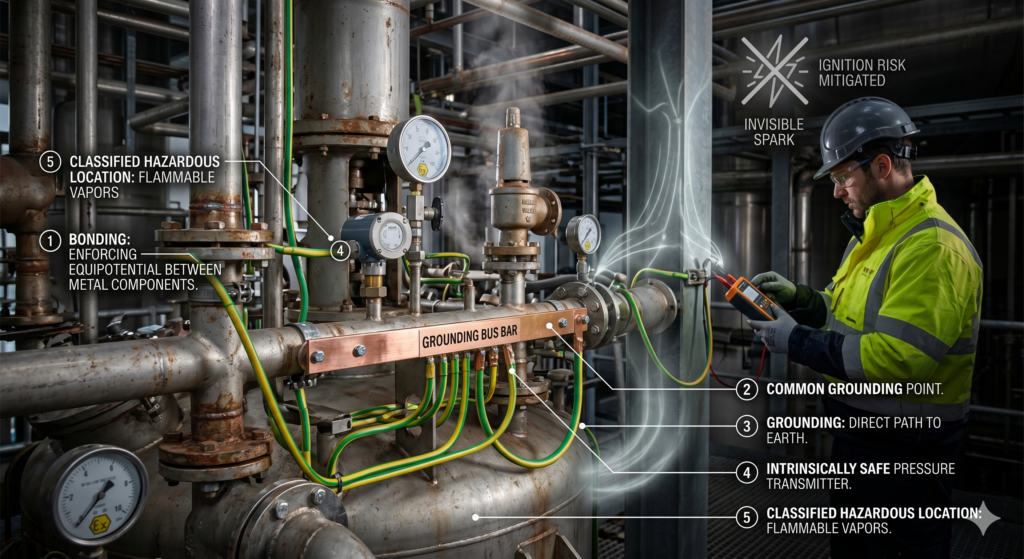
Grounding connects equipment to the earth to dissipate fault currents, while bonding connects two or more pieces of equipment to each other to equalize their electrical potential and prevent static sparks.
Why is static electricity so dangerous in hazardous areas?
A tiny spark from static electricity can contain enough energy to ignite flammable gases, vapors, or combustible dusts, leading to fires or explosions.
What is an equipotential plane?
It is a state where all conductive objects in an area are connected, ensuring they are at the same electrical potential, which prevents sparks between them.
How often should grounding and bonding connections be inspected?
The frequency depends on the environment, but regular inspections (e.g., quarterly or annually) and resistance testing are crucial to ensure the integrity of the connections.
Can I just visually inspect a grounding connection?
No, a visual inspection is not enough. You must use a low-resistance ohmmeter to test the connection and ensure it has a low-resistance path to ground (typically less than 10 ohms).
Chat for a Quote
Call: 832-699-6726
Conclusion
As we have explored, the principles of grounding and bonding are far more than just technical procedures; they are the fundamental language of safety in any environment where a flammable or combustible atmosphere exists. They are not interchangeable concepts but two distinct yet inseparable partners in a comprehensive strategy to eliminate ignition sources. Bonding acts as the great equalizer, creating an equipotential plane that connects every conductive component—from the largest vessel to the smallest valve handle—into a single electrical entity, ensuring that a difference in static potential can never build up and arc between them. Grounding, in turn, provides the ultimate safety net, anchoring this entire bonded system to the earth itself. This connection serves as a superhighway to safely dissipate any accumulated static charge and provides a critical, low-resistance path for dangerous fault currents to travel, instantly tripping protective devices and preventing catastrophic equipment failure and lethal electric shock. To neglect one is to compromise the integrity of the entire system, leaving a hidden vulnerability that a single spark can exploit.