

Intrinsically Safe Knowledge Base
How JSA and Intrinsically safe equipment help you in your workspace
Introduction to Enhancing Workplace Safety
A Job Safety Analysis (JSA) is a fundamental procedure that trains workers to perform their tasks safely and responsibly. When combined with certified Intrinsically Safe equipment, a JSA helps mitigate risks and prevent accidents, which in turn enhances overall productivity. To understand this synergy, consider a professional swimmer: they undergo rigorous training to develop their abilities, but they also use specialized equipment like performance swimwear and goggles to maximize their performance. Similarly, JSA provides the training framework, while Intrinsically Safe equipment provides the tools to execute work safely and efficiently in hazardous environments. This article explores how this powerful combination works in practice.
Job safety analysis
Some jobs involve tasks of danger or exposure that directly and indirectly harm the workers involved. So, the safety of the employees is always the primary concern. The JSA is an excellent training practice that helps all company members, from the CEO to the newest employee. The safety analysis predicts possible accidents and helps in the best development of the assigned task, listing the hazards according to their level of danger. It also improves communication and security awareness among everyone who participates in the company’s tasks.
Some jobs, more than others, require more attention to safety training. Therefore, working in hazardous areas requires training and appropriate equipment. Intrinsically Safe equipment is engineered to be incapable of releasing enough electrical or thermal energy to ignite a hazardous atmosphere, providing a critical layer of safety for the user. Below are some examples of work areas that require proper training and equipment.
- Oil & Gas facilities
- Petrochemical and chemical processing plants
- Mining
- Pharmaceuticals
- Grain handling/food processing
Intrinsically safe equipment
If your job involves the practices listed above, then you probably know the importance of training and the correct use of your work equipment. Combining JSA training with intrinsically safe equipment is a great work strategy that will result in safety operations. To develop this method, the first thing to do is, of course, identify through analysis what the hazards are, and for that, there is a list of essential points that help in the identification. Some of them are:
While performing assigned tasks or in their working environment…
- Are there machines or tools that present danger or constant maintenance?
- The Intrinsically safe equipment provided for the job?
- Is exposure to toxic, hot, cold, or acidic products?
- There is a free-traffic corridor that provides an emergency exit?
- What is the regularity of accidents in this work task?
- Is the worker have the proper lighting to develop the task?
These are just some of the points that should prioritize. Through the analysis, it is already possible to understand how thorough this safety research must be. Then, after defining the best safety strategy for your team, you can add intrinsically safe equipment as needed.
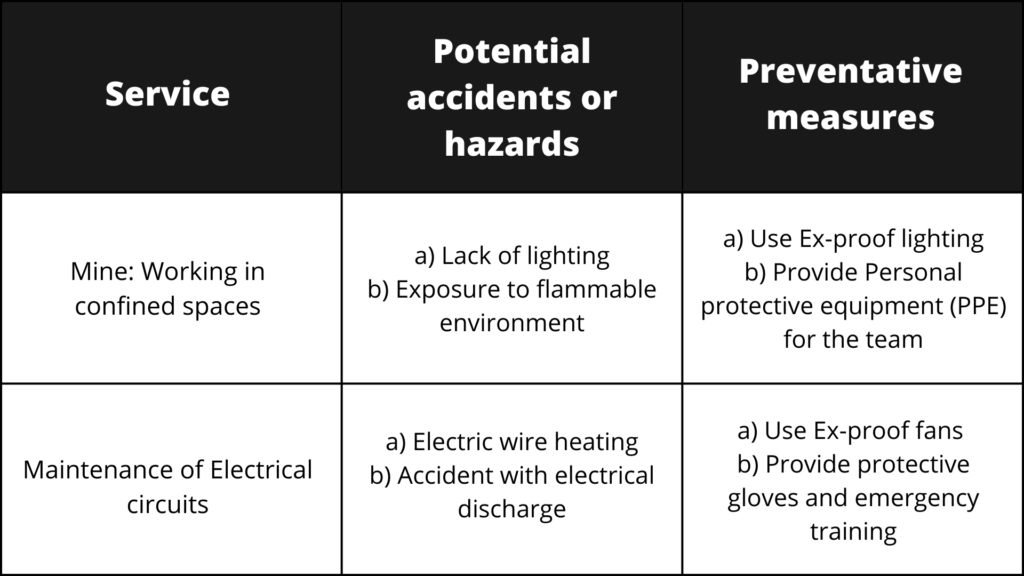
Below is an example of how this list might work:
Key Features & Benefits of Integrating JSA and IS Equipment
Combining a thorough Job Safety Analysis with the deployment of Intrinsically Safe equipment creates a comprehensive safety system that delivers multiple benefits beyond simple accident prevention. This integrated approach fundamentally strengthens a company’s safety posture and operational resilience.
- Proactive Hazard Mitigation: JSA is the diagnostic tool that identifies potential ignition sources and electrical hazards. Intrinsically Safe equipment is the solution, engineered to operate below the energy levels required to ignite flammable substances. This synergy moves safety from a reactive to a proactive model.
- Enhanced Regulatory Compliance: Adhering to standards from bodies like OSHA, ATEX, and IECEx is non-negotiable. A documented JSA process paired with certified IS equipment provides clear proof of due diligence, simplifying audits and ensuring compliance with hazardous location regulations.
- Improved Operational Efficiency: When workers feel safe and are equipped with the right tools, they can perform their tasks with confidence and focus. This reduces hesitation and work stoppages, minimizing downtime related to safety concerns and incidents.
- Strengthened Safety Culture: Investing in best-practice procedures like JSA and providing top-tier protective equipment like Intrinsically Safe cell phones sends a powerful message. It demonstrates a company’s commitment to employee well-being, which boosts morale, and encourages a culture where every employee takes ownership of safety.
Results: Better Performance!
Considering the example above, we can see how the analysis and strategy of JSA and Intrinsic safety facilitate the development of tasks. To make this process even more practical, the security management team can use technical table templates that specify the steps of the work task. Let’s take back the example of the swimmer athlete: you know they have the abilities and the training to hit the records, but imagine how their performance with the accessories and equipment will be. Therefore, integrating certified equipment as identified during the JSA is a critical step for achieving the safest and most efficient operational performance.
This equipment can include Intrinsically Safe devices like headlamps and gas detectors, or equipment using other protection methods like Explosion-Proof (Ex d) enclosures for items such as pumps and cameras. Those equipment and many others are part of the Intrinsically Safe Store sales catalog. You will find everything you need to ensure your safety method is complete.
Frequently Asked Questions (FAQs)
What is the main purpose of a Job Safety Analysis (JSA)?
The primary goal of a JSA is to systematically identify potential hazards associated with a specific job, analyze the risks, and establish clear, safe procedures to eliminate or control those hazards before an accident occurs.
How does Intrinsically Safe equipment differ from standard equipment?
Intrinsically Safe equipment is specifically designed and certified to operate with low electrical and thermal energy. This prevents it from creating sparks or hot surfaces capable of igniting flammable gases, dust, or fibers present in hazardous locations.
Can using Intrinsically Safe equipment replace the need for a JSA?
No, they are complementary safety measures. A JSA is the analytical process that identifies the need for specific protective measures, and Intrinsically Safe equipment is one of the critical tools used to fulfill those measures in environments with explosion risks. Both are essential for a comprehensive safety program.
Upgrade Your Safety Strategy Today
Ensure your team is protected with the right combination of safety procedures and certified equipment. The experts at the Intrinsically Safe Store can help you select the precise tools needed to mitigate the hazards identified in your JSA.